In recent years the reputation of Mary Seacole as a pioneering nurse of the Crimean War has been elevated far beyond the bounds of her own ambition. Meanwhile that of Florence Nightingale has taken an undeserved knocking, as Lynn McDonald explains.
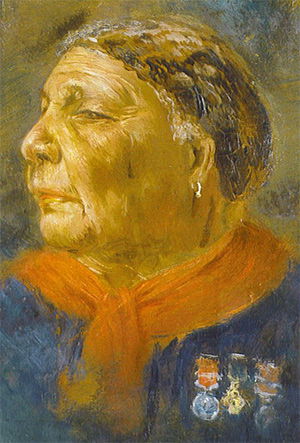
Jamaican-born Mary Seacole (1805-81), voted top of the list of the 2004 ‘100 Great Black Britons’ poll, is now slated to replace Florence Nightingale (1820-1910) as the true ‘heroine’ of the Crimean War. She is to be honoured as no less than the ‘Pioneer Nurse’ with a massive statue to be erected at St Thomas’ Hospital in London. This in spite of the strong links between Nightingale and the hospital, her base for over 40 years. It was there she established the first secular school for nurses in 1860 with funds raised in her name for her work in the Crimean War during the conflict of 1854-56. The Nightingale School operated for over a century from the hospital, whose redesign in the 1860s Nightingale also influenced.
At three-metres high, as the Seacole campaign points out, the planned monument designed by Martin Jennings will be visible from the Houses of Parliament across the Thames and taller than the statue of Nightingale at Waterloo Place and that of Edith Cavell in St Martin’s Lane.
Fundraising for the Seacole statue is supported by an audacious campaign, employing the same Seacole myths used to persuade the Guy’s-St Thomas’ NHS Foundation Trust to give over the hospital site. This permission was granted by its board of directors at a closed-door meeting in 2007, with no consultation with experts, the hospital’s governors or staff. The Lambeth Planning Committee, which approved the site at a meeting in April 2012, had no mandate to consider the merits of the statue or its message but only the technicalities of site, about which there was no objection.
The ‘history’ issued by the Guy’s-St Thomas’ NHS Trust in support of its decision brings several, now standard, fictions together. It credits Seacole with providing ordinary soldiers in the Crimean War ‘with accommodation, food and nursing care’ and with winning four medals for her ‘courage and compassion during the war’. It fails to mention any hospital in which Seacole ever nursed, trained or sent nurses, but simply asserts that ‘Britain’s black heroine’ gave her ‘life’s work’ for the ‘early development’ of nursing (Karen Sorenson, ‘Mary Seacole Memorial Statue Update’, July 20th, 2011).
The statue is to show Seacole with medals won for bravery, resolutely walking to the battlefield to treat the wounded, all points that feature in the makeover myth but do not survive a reality check. Seacole won no medals, nor ever claimed to have done so. She evidently wore three or four medals when back in London, including the Légion d’honneur. It was not at the time a crime in the UK to wear military medals other than one’s own – it has been since 1955.
Pictures speak louder than words. Many images of Seacole now depict her as a hospital nurse in a blue-and-white uniform. Black nurses today could well identify with this current portrayal of Seacole – she looks like an early version of a Jamaican NHS nurse. Yet she never wore any hospital uniform, for she never worked in a hospital. In the Crimea she dressed flamboyantly, as befitted the hostess of a restaurant.
White guilt is the likely explanation of this Seacole promotion and British whites have a lot to feel guilty about. Keenness for a heroic black role model is understandable, but why the denigration of another woman? Seacole herself had no grudge against Nightingale.
The vilification of Nightingale
The campaign promoting Seacole over Nightingale builds on 30 years of books, articles and films denigrating the latter. While she always had detractors, the serious assault on Nightingale’s reputation can be dated to 1982, with the publication of the Australian historian F.B. Smith’s Florence Nightingale: Reputation and Power (Croom Helm, 1982). The next major hit came in 1998 with Florence Nightingale: Avenging Angel (Constable, 1998) by a retired management consultant Hugh Small, which argues that Nightingale was actually responsible for the high death rates of the Crimean War and had a nervous breakdown as a result when she supposedly recognised this. Neither claim is supported by any serious documentation. Social media goes even further: see Facebook ‘Florence Nightingale was a Murdering Bitch’, later renamed ‘Florence Nightingale: The World’s Worst Nurse’, where she is described as a ‘deluded power hungry bitch’, who ‘looks like an uptight bitch’, so that ‘the day she died’ was ‘the best thing that ever happened to the field of nursing’.
The nursing profession was not responsible for either of the influential anti-Nightingale books, but neither did it defend her against them. It had been ignoring its founder for a long time; we look to the future, not to the past, nursing leaders said. Some jumped onto the bandwagon.
The Nursing Standard, a magazine owned by the Royal College of Nursing, which supports the Seacole statue campaign, has published more than 70 items on Seacole in the last ten years, many containing exaggerated or false claims. To quote just three examples:
‘Against all odds, [Seacole] had an unshakeable belief in the power of nursing to make a difference,’ and ‘changed the face of modern nursing’ (April 21st, 2004); Seacole: the ‘late, great nurse,’ through her ‘amazing acts of bravery and courage,’ was ‘a precursor to modern nursing’, who ‘saw beyond hospital wards and into the environment in which people live, and made links between psychological and physical illnesses’, (May 14th, 2008); Seacole was ‘a great pioneer and made a significant contribution to nursing’ (May 30th, 2012). But it was Nightingale who had faith in the power of nursing and changed the face of modern nursing. The Nursing Standard gives not a single example of a serious contribution to the profession by Seacole, who never claimed to be a nurse.
‘Real angel’ of the Crimea
Bashing white Victorian heroines is fair game these days, it seems, especially those of privileged background and the higher the status the more delightful the fall. The latest example, ‘Bringing Nightingale Down to Size’, by a doctor regurgitating F.B. Smith’s imaginative accusations was published in the British Medical Journal of March 2012.
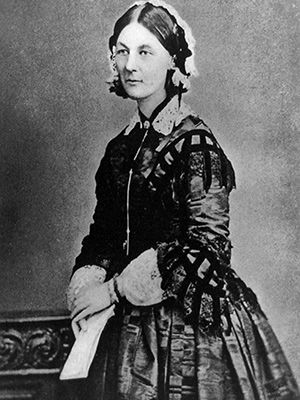
Florence Nightingale in 1856. Library of Congress
Two BBC films Florence Nightingale: Iron Maiden (2001) and Florence Nightingale (2008) have taken the down-with-Nightingale message to wider audiences. ‘Nightingale’s nursing “helped kill soldiers”,’ repeated The Sunday Times in a review of July 8th, 2001, while the 2008 film turned her into ‘The Liability with the Lamp’, (The Sunday Times, June 1st, 2008). Other BBC broadcasts, Mary Seacole: The Real Angel of the Crimea (screened on BBC Knowledge in 2000 and Channel 4 in 2005) and Mary Seacole: a Hidden History (2008) uncritically sanctify Seacole. In the latter Seacole is called the ‘real angel’ of the Crimean War, who ‘saved thousands of lives’.
It is time to look at what these two women actually did and did not do in the Crimean War, against what is claimed for and against them. Since Seacole wrote a remarkable memoir, Wonderful Adventures of Mrs Seacole in Many Lands, first published in 1857, we can read what she did in her own words (page numbers below are from the 1988 Oxford edition, the same as in the original edition). Nightingale left copious material on the war, including numerous letters pointing out defects and recommending action. We also have the carefully researched analyses done on her return, notably her 853-page Notes on Matters Affecting the Health, Efficiency and Hospital Administration of the British Army (1858) and her ‘Answers to Written Questions’ the same year, which was her evidence to the royal commission appointed to inquire into what went wrong in that war. These are reported extensively in Florence Nightingale and the Crimean War, volume 14 in the Collected Works of Florence Nightingale.
Seacole’s Crimean War
In her memoir Seacole traces her interest in war to her Scottish soldier father, which gave her sympathy with the ‘pomp, pride and circumstance of glorious war’ (p.1). She next admitted to a longing to ‘witness’ war, especially since regiments she knew in Jamaica were leaving for the ‘scene of action’ (p.73). When the war actually began in late September 1854 Seacole was in London to look after her gold-mining stocks (p.74). Newspaper advertisements invited applications for nursing posts, but Seacole never applied. Instead, after Nightingale and her 38 nurses had left, she set out to join a later contingent of nurses, one Nightingale knew nothing about. Seacole made the rounds of offices, beginning with that of the junior war minister, Sidney Herbert, but he neither interviewed nor hired nurses and declined to see her. She did not get an interview anywhere else she tried, but whether or not for reasons of race is not clear. She was old for hospital nursing, nearing 50, and had had no hospital experience, despite the frequent claim that she ran the nursing at an army hospital in Jamaica – not a claim she ever made herself.
Seacole then decided to go on her own. She would set up the ‘British Hotel’, which she advertised as a ‘mess table and comfortable quarters for sick and convalescent officers’ (p.81). She had used the name earlier at an establishment in Panama, but neither it nor the Crimean establishment took overnight guests – both were restaurants with stores. The Crimean venue also had a ‘canteen for the soldiery’ (p.114), no further details given. Seacole had a business partner in her Crimean enterprise, Thomas Day, a relative of her late husband.
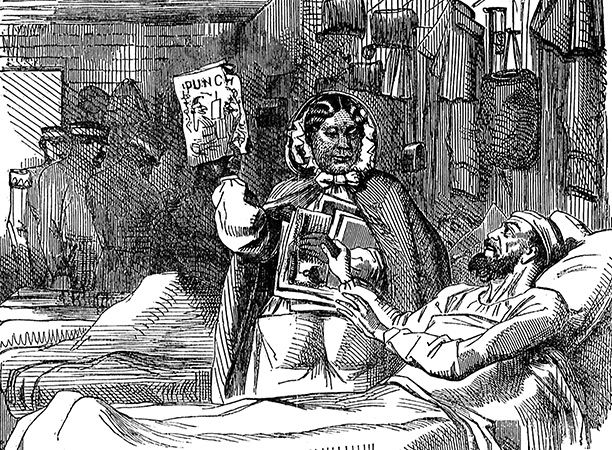
In May 1857 Punch mocked Seacole's worthiness for a fund in her name. 'Our Own Vivandière' shows her, misleadingly, with a wounded soldier in hospital.
Seacole devotes chapters of her memoir to the British Hotel in the Crimea, to its high-ranking visitors, including a French prince, a duke and a viscount and the meals she served them. She also recounted the challenges of obtaining supplies, unreliable employees, rats and thieves. Clearly the British Hotel was her major occupation, but she also did voluntary work, such as taking tea and lemonade to soldiers waiting on the wharf for transport to the general hospitals in Turkey.
Officers could get a meal at Seacole’s, or send a servant to pick one up for them. Among the available items were tins of salmon, lobsters, oysters, game, wild fowl, vegetables, eggs, sardines, curry powder, coffee, currant jelly and non-food items such as saddles and boots:
I often used to roast a score or so of fowls daily, besides boiling hams and tongues. Either these or a slice from a joint of beef or mutton you would be pretty sure of finding at your service in the larder of the British Hotel. (p.138).
I often used to roast a score or so of fowls daily, besides boiling hams and tongues. Either these or a slice from a joint of beef or mutton you would be pretty sure of finding at your service in the larder of the British Hotel. (p.138).
After the war was effectively over, but before the peace treaty was signed, she catered for excursions, cricket matches, picnics, theatricals, dinner parties and races, providing soup and fish, turkeys, saddle of mutton, fowls, ham, tongue, curry, pastry of many sorts, custards, jelly, blancmange and olives. For Christmas there were plum puddings (recipe provided) and mince pies. In hot weather she provided sangria, claret and cider cups. On the last excursion described in her memoir she brought a hamper of ‘a cold duck and other meats, a tart’ (p.190).
Seacole described ‘the officers, full of fun and high spirits,’ crowding into her kitchen and carrying off ‘the tarts hot from the oven, while the good-for-nothing black cooks ... would stand by and laugh with all their teeth’ (p.141). Her customers were officers and others of that class and the food and drink provided far beyond the means of ordinary soldiers. There is nothing intrinsically wrong in this, but there is in the claim that her mission was to save the lives of ordinary soldiers, which was in fact Nightingale’s mission.
One children’s book gives such fake details as that Seacole ran a hospital alongside the shop and restaurant, where she ‘nursed the soldiers from 5am until midday’ and then to go onto the battlefield (Emma Lynch, The Life of Mary Seacole, Heinemann, 2006). Another has her taking teams of nurses onto the battlefield with her, after she had been rejected from nursing ‘because of her race’ (Kay Barnham, Florence Nightingale: The Lady of the Lamp, White-Thomson 2002).
In fact Seacole was present at only three battles, the Redan assaults on June 18th and September 8th, 1855 and Tchernaya on August 16th. The three major battles took place in the autumn of 1854, before she left London: the Alma on September 20th,, Balaclava on October 25th and Inkermann on November 5th 1854. Even those battles were only a day long; the ones Seacole viewed were over in hours. Prior to Redan she had got a brief glimpse of action when, on horseback, she accompanied Omar Pasha and some Turks to a Russian outpost. She gave no further details as to what happened in the battle, but judged the experience ‘pleasant enough’ and even the source of ‘strange excitement’ (p.147).
Visitors and officers’ wives watched the (failed) assault on the Redan from nearby Cathcart’s Hill. Seacole described getting wind of the first assault the day before and preparing for it before daybreak: ‘We were all busily occupied in cutting bread and cheese and sandwiches, packing up fowls, tongues and ham, wine and spirits.’ These were loaded on two mules, ‘in charge of my steadiest lad’. She herself led the way on horseback, with a bag of lint, bandages, needles, thread and medicines. The British soon retreated, so that freed-up officers became customers for her refreshments. She then made her way to the temporary hospital (set up by the army), where she assisted with the wounded waiting for admission. There, her memoir states, she bound up wounds and gave cooling drinks. The mules and the steady lad, meanwhile, had moved off. After she found them and whipped the negligent boy she saw some more wounded, ‘with whom I left refreshments’ (p.158).
All this shows Seacole to have been spunky, generous and worthy of praise. But it does not demonstrate that she worked as a nurse or that her actions saved thousands of lives. Neither does it confirm her acceptance as a professional colleague by doctors, as some have claimed. Her earlier ‘tea and lemonade’ gifts, she herself noted, were ‘all the doctors would allow me to give to the wounded’ (p.101).
In the Crimea, Seacole ran a business, as she had throughout her life. Like her Jamaican mother, she owned and operated a boarding house in Kingston, mainly for army and navy officers and their wives. Neither ran an invalid hospital nor nursing station, as is often stated. After she married Edwin Horatio Seacole in 1836 the two ran a store together. On an earlier visit to Britain she had earned her living by selling Jamaican preserves and pickles (p.3); while travelling in the Bahamas she acquired shells and shell work to sell back in Jamaica (p.5).
A doctress
In the Crimea, as in the Caribbean, she pursued her vocation as a ‘doctress’, or traditional Creole herbalist, alongside her business. She charged for her remedies, but gave them free to those unable to pay. In Panama, where she lived for over two years, she first helped her brother run his hotel, then opened her own shop. She faced a cholera epidemic in a small outpost where there was no doctor. She claimed some cures for her treatments, but also ‘lamentable blunders’ and admitted that she shuddered when she thought of some of those cures she had tried for cholera (p.31). She describes adding ‘sugar of lead,’ the toxic lead acetate, to a cholera remedy to make it work, a point that is not mentioned by her present-day supporters. In fact we know nothing of the precise ingredients of her cures, for she left no details. Claims such as those made in the film, Mary Seacole: A Hidden History, that Seacole functioned not only as a nurse, but as a ‘very good doctor’ and a ‘very intelligent pharmacist far in advance of British medicine’ are sheer speculation.
In the Crimean War Seacole’s ‘patients’ were all walk-ins. The army sent its most serious cases to the general hospitals, mostly under Nightingale, the less serious to regimental hospitals. Men with lesser ailments such as headaches and stomach complaints took themselves to the British Hotel. Seacole describes leaving her food preparations in the kitchen to serve ‘patients’ in the store (p.125). Unlike any hospital, the British Hotel closed nightly at 8pm and all day on Sunday (p.145).
Seacole’s business did well for a year but went bankrupt when a peace treaty was signed on March 30th, 1856 and the British Army began to depart. Seacole had laid in expensive provisions which could be sold for only a fraction of their outlay. She described taking a hammer to cases of red wine, rather than let them be taken by the Russians (p.196). After the war friends raised funds to enable her to start another business and she briefly opened a store in Aldershot. However it, too, failed. Later a trust fund was raised for her so that she could live at ease – she returned to Jamaica, before finally settling in England in 1865. Consistent with her census entry shortly before her death, showing that she lived on independent means, her will shows her to have died prosperous.
The Seacole campaign has not only changed her occupation, but her race. She was three-quarters white and proud of her ‘Scotch blood’ (p.1). She had nothing good to say about her African/Creole heritage, but made a point of distancing herself from the ‘lazy Creole’ image (p.2). Seacole refers to ‘Blacks’, ‘negroes’ and ‘niggers’, throughout her memoir, but she never uses any such word for herself. She employed a black maid and the above-mentioned ‘good for nothing black cooks’. In her own words: ‘I am only a little brown – a few shades duskier than the brunettes whom you all admire so much.’ (p.4)
Seacole supporters have Nightingale living a life of safety at her hospital in Turkey, far from the battlefield. True, she and her nurses were 300 miles away, across the Bosphorus from Istanbul (then Constantinople), at the hospitals to which the British Army sent them. But these were dangerous places and many doctors and nurses died of disease. Nightingale herself nearly succumbed to ‘Crimean fever’, probably brucellosis, a disease not identified until the 1880s.
Her barrack hospital at Scutari was then the largest in the world, but it was never intended to be a hospital and lacked such basic necessities as running water, functioning toilets, laundry and operating theatres. Its sewers and drains were grossly defective, faults reported by doctors months before Nightingale arrived. But renovations were not started until March 1855, with the arrival of a sanitary commission headed by Dr John Sutherland (1808-91) with Robert Rawlinson (1810-98), a leading civil engineer and water expert, and James Newlands (1813-71), the pioneering borough engineer of Liverpool, who supervised the clean up. Both Sutherland and Rawlinson subsequently became Nightingale’s close collaborators.
Nightingale’s hospital had a high death rate, but so did all the army general hospitals. Contrary to statements by Hugh Small, who did not use the full mortality statistics available in Avenging Angel, the highest death rate was at Kulali and reported as such by Dr Sutherland – a hospital not under Nightingale’s supervision but nursed by the Irish Sisters of Mercy. They, no more than Nightingale, should be held responsible for its death rates, for they, too, were working where they were sent and should hardly be blamed for the state of the sewers and drains. Nearly half the deaths from disease in those hospitals were due to bowel diseases.
Frequently unrecognised is the dirty work Nightingale took on as a result of those defective sanitary arrangements. Her own report notes the flowing faeces on the floor and the pertinent fact that the men generally had no shoes or slippers. Tubs were provided in the wards for those who could not walk to the toilet areas. Nightingale herself organised the orderlies in the morning to remove the excreta. But this ‘underside of history’ is simply ignored in both the book and film coverage of the war.
Nightingale’s work during the war included hands-on nursing, the management of nursing at several hospitals and writing to remonstrate with officials back in England on the desperate conditions. She set up new systems, established laundries and kitchens, reducing cross-infection and improving nutrition. She did much to make the life of the ordinary soldier better, including establishing coffee and reading rooms for those convalescing after treatment. She also wrote to families informing them of the deaths of loved ones. She did not save thousands of lives during the war but her research and recommendations after it saved many more. The honour of actually reducing death rates at the war hospitals must go primarily to the sanitary commission and also to the supply commission, headed by Sir John McNeill, another Nightingale ally, which made the crucial improvements in nutrition, clothing and shelter.
Making a difference
The sheer scale of the death rates of the Crimean War seems to have escaped the notice of many commentators: 22.7 per cent of the troops sent by the British Army died, 30.7 per cent of the French army. Firm data is lacking for the Russians (and the Turks) but the figure is probably higher. By comparison, the death rate in the US army during the Vietnam War was 2.3 per cent.
The French were the instigators of the Crimean War, sent more troops and were better prepared than the British. Their death rates were lower in the first year. But the British government learned from the commissions it sent out and made enormous changes. British death rates fell dramatically, from 23 per cent in the first winter to 2.5 per cent in the second – no greater than deaths among soldiers in peacetime barracks in London, as Nightingale proudly showed in a chart. In contrast, the French (lower) 11 per cent death rate in the first winter, rose to 20 per cent in the second winter. Since the French were late in publishing their statistics, neither Nightingale nor the royal commission could use them for comparison. However French doctors themselves credited the British reforms for their superior performance. Once they were properly cleansed and functioning Nightingale was proud of the Crimean hospitals. In her own charts she separated the two periods, before and after the sanitary and supply commissions, to emphasise the crucial role they played in reducing mortality.
Her analysis of what went wrong was widely accepted and led to major changes to health care in the British Army. The ‘Nightingale Fund’ raised in her honour for that work paid for the training school at St Thomas’, which led to raising nursing to the level of a profession throughout much of the world. Her experience of the war, and her reputation and research as a result of it, grounded all the social and public health work she did for the rest of her life. Her vision for health reform included bold statements, such as the belief that the poor should receive as good quality hospital care as private patients and warnings as to the dangers of hospital acquired infections. Nightingale, in short, is no mere historical figure. Her lamp should not be retired but shone brightly onto the hospital and health care problems of today.