Of course playing off the cliche: "If a tree falls in a forest and no one is around to hear it, does it make a sound?" But to clarify the meaning, in a nutshell, it's a philosophical thought experiment that raises questions regarding observationand knowledge of reality. So contemplating on the same plane of knowledge and existence, if a book was indeed written but no one reads it, does the book still have a soul?
Having posing this question to other authors, all say "yes!" The life brought into the story is evidence of the books existence, thereby concluding it does posses a "soul," as it were. Like all living beings giving birth, life breeds life.
But I raise the question of why writers write, and how their existence is influenced by the deepest desire to have their voices heard. Even through the argument that an artist should only write for her or himself, without worry of an audience, yet still, writers wish to share their art; and by sharing, an audience is needed, regardless of size. So, once a writer has composed words onto paper, but no one "listens" to the interpretations, how is the connection and kinship shared? To create life is one form of the soul, but to sustain it, to give it purpose, that is the destination. If a reader doesn't know the existence of the book or chooses to not read it, endorsing George Berkley's observations about whether something can exist without being perceived, does that book truly exist? And if that book doesn't exist, can it truly have a soul?
Whether a tree does make a sound, or whether a book does encompass a soul, to be perceived is the question of any argument. Naturally the answer is bi-polar in examination. Shared knowledge is a writer's ambition, and that is the only reality a writer is able to express.
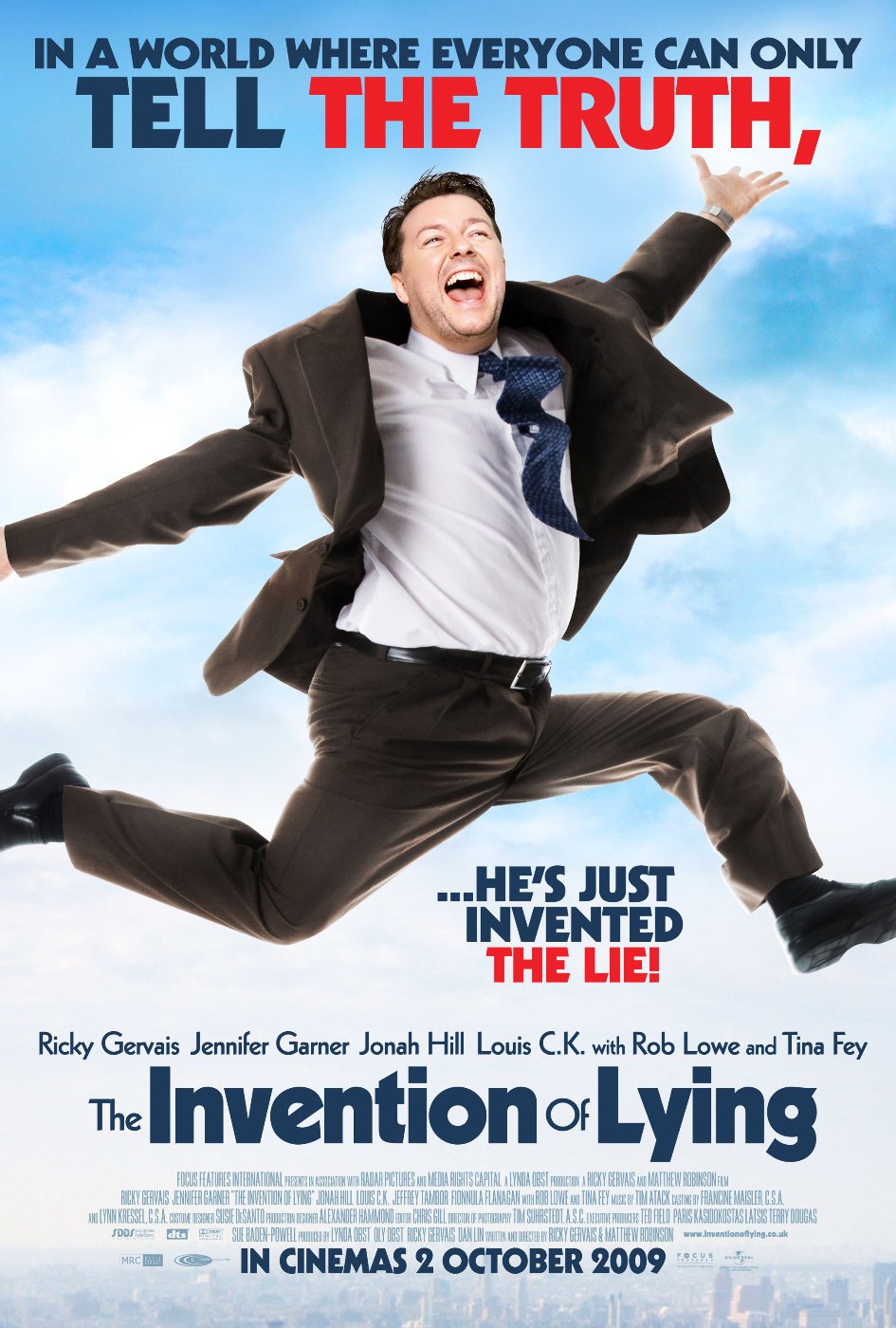
An obvious cliche is defined by one the most natural and primitive motive by human nature: lying. Why is it such a cliche? Well, I’m not going to blow smoke up your ass, or tell a cock ‘n bull story, or pee on your leg and tell you it’s raining, because, I’m quite sure you’ve heard it all before so I don’t need to reinvent the wheel. The art of lying is much older than the oldest profession in the world, and yes, both are considered viral and can be harmful. After all, who wants to get caught with their pants down in either situation?
Of course lying leads down the road of questioning morality. Large lies are destructive. Marriages and friendships fall apart. Wars rage on. Politicians stay in business. You know the deal. Small lies are forgivable. We don’t want to hurt people’s feelings with the small stuff. Or we just don’t really feel like going to work or taking our kids to the park because we’re just too tired and need a break. So the margin between how we justify telling lies can easily be deluded or misunderstood, thereby creating this moral conundrum.
I am one of the biggest liars I know. Every time I sit in front of a computer I tell lies consistently, obsessively. Why? Because I write fiction. The stories I tell are half true, half false. And the best part about it, you believe what I tell. When you begin to process that concept, it’s really an incredible experience we both share, and it’s as natural as breathing. Logically we should reject this acceptance. My father, the engineer, rejects it. He doesn’t read fiction because he would rather fill his mind with information that’s legitimate and direct. But for the rest of us, we not only marvel in it, we dip our entire souls into it because it feels good. It releases a part of our imagination that we can’t operate in the physical world.
So, yes, I write fiction. And I write fiction with a historical twist. Although I dig deeply into research, I chose to reproduce history in a fictitious form. It’s like having immunity. I can break off story lines from real events, and then turn around to commit forgery without blame. If you think about it, it sounds bad; however there is a legitimate purpose. Fiction, like all other art, serves a higher calling. It allows an opportunity to blend real-life people into one character as a representative, a symbol of who that character represents, whether a crusader for equality or an irredeemable brute, to bring forth criticism and awareness. Fiction doesn’t fall far from the truth. It has to come from somewhere authentic, otherwise readers will have no commonality to grasp upon.
I believe writing about history in a fictional context can be intellectually, spiritually, and humanely liberating. Fact or fiction, the art of lying unveils misconceptions about ourselves, our humanity, and our future. We lie, we reinforce. We gossip, we self-destruct. We seek, we fail. We grow, we die. But always we hope. To escape. To learn. To rediscover. To reinvent. It matters, all, it matters because we are here. I encourage this philosophy: Submitting to a moment in time allows us to remember, or to muse even, over our society’s past. Although writing can educate as well as entertain, yet what makes art incredibly amazing, to that of paintings, photographs, and music, it transposes emotion into another form of humanity, and therefore, it is our humanity which keeps all of us striving for an improved future.
So, if you think I’m trying to pull wool over your eyes, or even trying to pull your leg, then you’re right. I am. That’s my job. And I hope you ponder over what I tell you. Let us explore our vices outside of our everyday life. Let us think about how reading fiction, that, although is regarded as false and abstract, can reveal truths about ourselves. About our humanity. And allow a freedom to examine these controversies with creativity and heart. This type of lying can actually be a good thing.
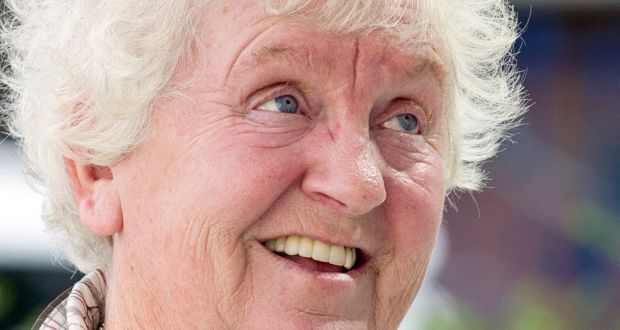
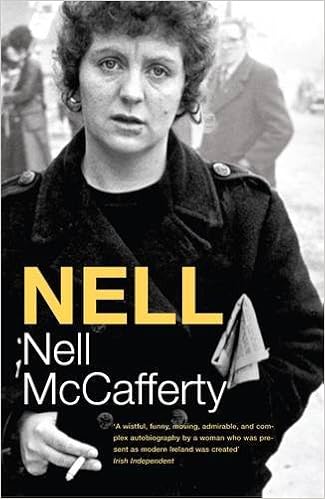
In the kitchen of her lovely old redbrick house, Nell McCafferty apologises for the lack of biscuits. As I sit down at the table and she makes tea, I get the feeling that this is the kind of kitchen where visitors are regularly treated to home baking. The house, the kitchen, the invitation to tea send me certain messages. Homemaker. Breadbaker. It is an interesting backdrop for a woman who is known as a cantankerous feminist, barricade stormer and some-time IRA defender.
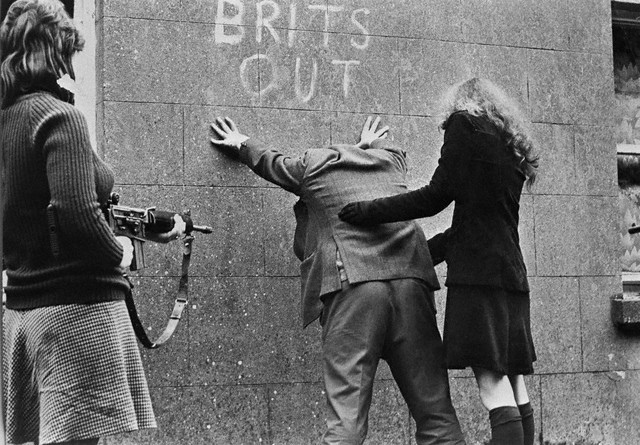
Feminism and republicanism are very much in the news at the moment. After the murder of their brother, Robert McCartney, by IRA members, The McCartney sisters have dominated news about Ireland. Their demands that the killers be brought to justice have thrown traditional support for the IRA in Catholic communities in the North into question. McCafferty, who describes in her book how she was shunned in the past because of her “refusal to condemn a neighbour’s child”, has her roots in that same community. What does she make of the events? “I think it has changed everything. It is obscene what happened to those men [a number of men were beaten in the attack]. The McCartney sisters are from a Republican background, and would have supported the IRA as defenders of the community. Now that has changed – what they see, what we are all seeing is that the IRA will kill you, kill their own. It is a terrible shock that members of the IRA could conduct themselves like a murderous gang”.
But was it not well known already, what the IRA was up to? Can it really be a surprise that an army kills? McCafferty vehemently rejects this. “This is different. I am not saying I am suddenly waking up and smelling the coffee. Sure, human rights were violated, we were under siege and there was a war on – but not like this. And now the war is over, has been over for 9 years. Sinn Féin wanted the IRA to stand down. OK, there were a few difficulties with certain people, but we thought the IRA wanted the IRA to stand down. Now I don’t know. Perhaps there will be a split, which would be terrible because it could bring back the guns”.
She is critical of media who she feels have not covered the story well enough – not spelling out exactly what happened on that night in Maginnis’s pub in Belfast. She believes people need to know what happened to understand why this is a real watershed. “The community is deliberately out on the streets applauding these women. This is the hand of the community in the back of the IRA saying, ‘Go now’. Once women sanction revolution, there’s no stopping it”.
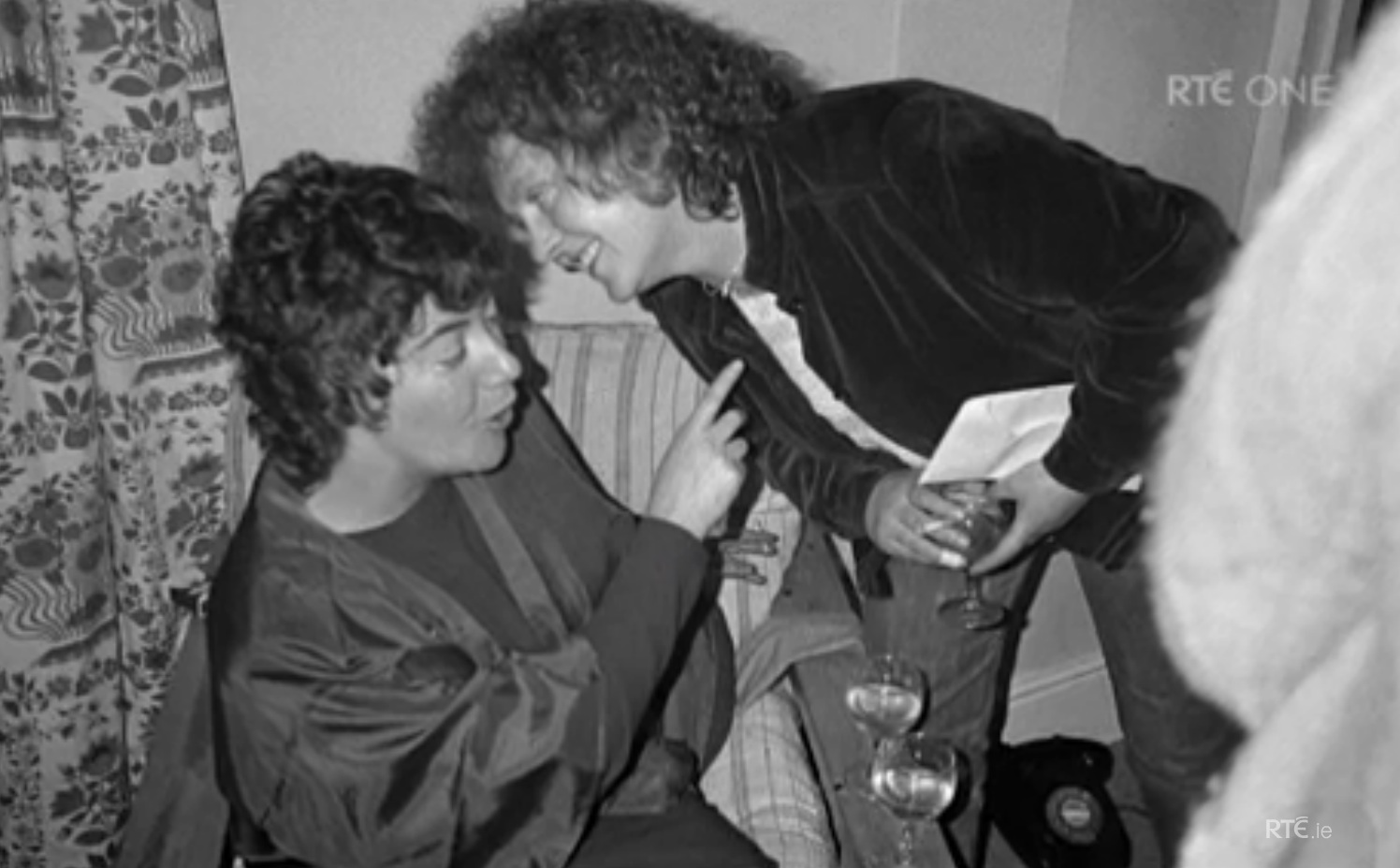
Women and rebellion is something McCafferty knows a lot about. Having grown up in Derry, she was at the centre of Northern Ireland’s civil rights movement for equal votes, homes and jobs for Catholics. McCafferty was there on Bloody Sunday in 1972, when British soldiers shot dead 14 marchers in Derry. She also campaigned on behalf of republican women in jail. She moved to Dublin in 1970, and as a journalist opened many people’s eyes to what was happening to the most vulnerable in Irish society when she wrote about the children’s courts. She soon became part of a small but vociferous group of women who started the campaign for equality and women’s rights. She went on the famous contraceptive train – a group of Irish women went to Belfast, stocked up with condoms, pills (which, she reveals in her book, were actually aspirin, but customs never knew that) and other illegal articles and brought them back to Dublin. Here they were met by police and waiting media. Yes, it is true: 30 years ago, contraceptives were still illegal in the Republic. Pints were another thing women could not have – and so the same women went in to a famous pub in Dublin’s city centre, ordered 40 brandies, waited for them to served, then ordered a pint. The barman refused, and they in turn never paid for the brandies.
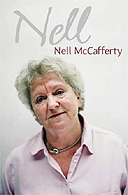
Nell McCafferty’s autobiography, Nell, published in November 2004, is full of great stories both from the civil rights, and women’s struggles. Despite dealing with deadly serious issues, McCafferty says feminism was fun. Her wit, compassion and sense of the ridiculous, used with such great effect in her journalism and campaigning, are much in evidence throughout the book.“We enjoyed the struggle, at least at the beginning. It was like shooting fish in a barrel, the obstacles to women were incredible, ludicrous, and stood out like a sore thumb. Ireland was full of men in suits who never had to deal with the likes of us before, and to see them challenged by someone as formidable as Mary Robinson – it was great. It is terrific if you are a revolutionary and you can achieve the revolution in a short time!“
Although not now actively involved with any organisation, McCafferty is still considered a prominent feminist, and regularly asked to “do gigs”. They day we met, she was due to speak later that evening on the subject “Has feminism gone too far”. She says the organisers have assumed she would be on the politically correct side, but “perhaps they should not be so sure”. She says she wonders if life has really become better for women as they deal with all the new pressures of juggling work and home, marriage breakdown, and running several families. “At first it was so simple, the obstacles so obvious. Now you are dealing with all the complicated stuff – three jobs, childcare, commuting, three children by three fathers. I do not have the answer, and I am glad I don’t have to deal with it. My excuse is always: don’t ask the prophet for a blueprint! I prophecised that we must work outside the home, but I never said how it would be done exactly. I just sketched the big picture, someone else deal with the details. I have forgiven myself for not providing the blueprint: that is not my job – someone has to look at the big picture first! I keep asking, and I really want to know, how are you going to make it work? Who is out there looking for a solution? I am bemused there is no great cry from women, and men; but I guess it is just a fallow period at the moment. Change will come. I think it takes 20 – 30 years for each generational change to really seep through. And jobs for women outside the home have only really happened in Ireland in the last ten years. But I do wonder, are you all happier now!? “
It is interesting that the role model for this feminist prophet was a traditional homemaker – her mother Lily. Central to McCafferty’s book is a fascinating and moving portrait of her mother, a truly remarkable woman who seems also to embody McCafferty’s statement about women sanctioning the revolution – as well as feeding the revolutionaries! Lily jumps off the pages and we see clearly how she inspired and supported Nell throughout her life. “My mother was one of the last of the full-time homemakers. We lived like royalty, she did everything for us. She never had her own job, and I know she would have liked to have her own money and not have to wait for my dad to hand it over. But she loved looking after us, and lots of other people too: she always had an open house where everyone was welcome. In 1968, when we were all reared, in a way she was redundant – but then civil rights happened, she became active in local politics and her house became a political salon and part-time refuge. Our house was always at the heart of the local community, and my mother was very much at the centre of it. All the neighbours came to my mother with their problems. There were a lot of things people could not talk about –but mammy would talk about it for them!”
However the one thing that could not be discussed was the fact that Nell was gay. Despite their terrific relationship, it remained a closed subject. Yet McCafferty opens her book with a declaration of her sexuality. She says she was “terrified” of her mother’s reaction. “Once the book was out there could be no ambiguity anymore.At the start, I was not sure if I could publish it while she was still alive. When I started the book, I decided to write everything down, and said to myself I could always take things out! But when it was done, – well, I felt this was the time, I had to be honest. So I took a deep breath and sent it off. I was terrified though, of how my mother and the neighbours, our street, would react. They have been through everything else – war, wife beating, rape, marriage breakdown –this was the last taboo."
Lily McCafferty died just before Christmas, soon after the book was published. McCafferty is very glad now that her mother got to see it. “Thank God I got the book out. It would have been a big ache in me if I had not got a chance to show it to her. She could not read it, she was blind at the end, but my sister Carmel read parts of it to her. She read the opening paragraph, which was enough… And mammy saw me on the Late Late Show telling parents watching with their secretly gay children to tell them they loved them.” She says Derry was the ‘acid test’ – what would the reaction be of old neighbours, her mother’s friends. The Saturday after she had been on TV, she was in Derry for her mother’s 94th birthday. And in they all came, ”with in one hand a gift for my mum and in the other my book, asking me to sign it. I knew then it was OK.”
Another interesting thing about Nell is that it is dedicated to two nuns. It was a surprise to me that someone who has been so critical of the Church has such admiration for “holy women”. “I was blessed by them; two nuns who listened to me, showed me compassion, made it possible for me to go on when I was discovering what it meant to be gay. When I confessed to a priest that I was in love with another girl, he refused me absolution. I walked away and never went back to the Church after that day. But the nuns were gentle with me and I am full of gratitude for that. I was very religious growing up. It was what kept us going: we were God’s children. Protestants might have everything else but they would not go to heaven. It was real opium for the masses – and we believed that one day we would be free! I envy people now who have faith. In the lead up to my mam’s death, I can see how it is a comfort to people. And there is a lot of good sense in the Ten Commandments: give us today our daily bread – that phrase is people demanding their right; to be free from hunger; it is a civil rights demand. The holy men have just got in the way of the message of social justice. But I still have faith in the holy women”
The book is also a very personal, very intimate portrait of its author. Several chapters describe McCafferty’s relationship with Nuala O’Faolain, who McCafferty describes as “the love of her life”. Why did she feel it important to record it in such detail – and was she not worried about being so open about something so deeply personal? Does it not make her vulnerable? “No, not at all. I think that is what you do when you tell a love story – and I could not tell the story of my life without including it. I am more worried about what I did not include – I think there was much more to say! I wish I had captured more of the joy, more about our travels, things we did together. I am surprised when people ask me this – do they not think I had a domestic life, that I just walked around carrying placards all day? My only worry about this is whether I was fair to Nuala. I am not worried about saying I love someone. To me it is one of life’s greatest achievements. “
The last few months have clearly been difficult for McCafferty. She says she has not been able to sleep at night since December 16th – the day her mother died. Having spent the last four years caring for her mother, and also writing her book, a very disciplined life has given way to what she describes as “living in the twilight zone”. “I am glad though that I can take the time to absorb it. I have not really had a chance to talk or think much about what next. Right now I have no vision, no ambition, no objective. I am a woman in waiting. I am not usually very good at metaphors, but a friend of mine, Margaret McCurtain, does not say how are you – she always says “how does your garden grow?”, What I am thinking now is, I forgot to plant bulbs, I was busy doing other things – but sure something will come up in spring. I like figuring out problems, there is an answer to everything. But right now I have not got the energy to identify the problem. But I am sure that will come, in time".
John Steinbeck wrote as part of his Noble Peace Prize speech
in 1962: “The writer is delegated to declare and to celebrate man's proven
capacity for greatness of heart and spirit—for gallantry in defeat, for
courage, compassion and love. In the endless war against weakness and despair,
these are the bright rally flags of hope and of emulation. I hold that a writer
who does not believe in the perfectibility of man has no dedication nor any
membership in literature.” And within
the same context, he also wrote, “I have come to believe that a great teacher
is a great artist and that there are as few as there are any other great
artists. Teaching might even be the greatest of the arts since the medium is
the human mind and spirit.”
How can one not be in awe of his perception? As a writer, even in fiction, Steinbeck broke
boundaries of how to reconcile what is humane.
He mixed literary prose and realism with such grit and fortitude that
I’m charmed by his depressing and enriching style. The Grapes of Wrath and Of Mice
and Men are still inside my head, and in fact I have made soft suggestions
to both books in my WWII novel, Eyes Behind Belligerence. I named two of my characters Tom and Rose,
(although they are married and not brother and sister,) as a quiet dedication
to The Grapes of Wrath; and even slid in Of Mice and Men as a
favorite book of one of the protagonists in an effort to understand who has the
right to take away someone’s life. It
also plays into effect of bonding between two unlikely friends who only share
the commonality of their environment.
I discovered Steinbeck in high school, as many secondary
students have before me in English classes.
I’m grateful he was included as part of the curriculum. Up to that point in my life I had not read
that many “goddamns” and “bastards” in YA fiction. In fact, that was the first time I learned
how to spell other swear words not often read in bathroom stalls that rhyme
with Nantucket. And
spelled correctly, I might add. I began
counting how many times these “goddamned bastards” appeared in Of Mice and
Men. And yet we weren’t allowed to
say them in the classroom if we weren’t reading the texts out loud. The reason I bring this particular topic up
is to explain how I began to comprehend a coarse, migrant lifestyle from people
who came out of the Dust Bowl. The book
opened up another world and I loved it.
Not only did I want to be a part of that world by continuing to read
John Steinbeck, but I wanted more. I too
wanted to write about the depravity and faith mankind.
Initially I wanted to be an artist- mainly focusing on
drawing and painting, and I do have a graphics art degree in addition to a
history degree. Because I’m dyslexic,
reading and writing came to me slowly as a child, and I somehow compensated by
memorizing the structure of words. Up
until I was a teenager, I didn’t believe I had any other talent. It has taken me some time to find courage to
peruse a writer’s career. I have a
highly creative brain that engages in any creative outlet possible- including
writing, which later has dominated my desire to be creative both visually,
(describing scenes like describing paintings,) and intellectually. And as a
teenager, while investigating American history, I came across the
Japanese-American internment camps. When I learned more about the camps I felt
compelled to then write about these camps. Why?
I don’t have any Japanese ancestry in my family tree. I live in the Midwest
and grew-up in a medium size town where cultural diversity is a bit
underdeveloped. My reason is
simple: I don’t want to continue to live
in a conical world. Consciousness does
not develop and mature by existing in a frozen pond. I wanted to write about issues of camp life
that has never been written about before in fiction. Much like what Steinbeck
did when writing about migrant workers during his time.
I like to believe that after decades worth of introspection
we have learned more wisely than something that happened yesterday. And that’s why I love history: To learn. To
question. To redeem our humanity. My philosophy is this: “Submitting to a
moment in time allows us to remember, or to muse even, over our society’s past.
Although writing can educate as well as entertain, yet what makes art
incredibly amazing, to that of paintings, photographs, and music, it transposes
emotion into another form of humanity, and therefore, it is our humanity which
keeps all of us striving for an improved future.” I think John would agree on some transcending
level.
When I rang the door bell in the summer of 2000, a plump man in his late seventies answered. He looked similar to Rodney Dangerfield, especially in the nose. We had never met before, and I wasn’t certain if my friend, who had initially invited me, informed him about my arrival. The writer’s meeting was supposed to start at 7:30 p.m. every Thursday. It had been a ritual for nearly a decade. He tilted a half smile anyway, eyes beaming at a pretty girl, and invited me in. His white T-shirt and dark, crinkly slacks was not the style I had envisioned. Also, it was evident he needed a hair cut because the length reached over his ears. I had envisioned a distinguished beard or pipe or even a brown sweater with leather patches at the elbows. After all, wasn’t that a standard for aging writers?
I followed him into his dining room, a short distance from the front door. He had a slight limp, which later I learned about his club foot, one of the many difficulties he overcame in his long life. In the middle of the room stretched a lengthy table. He sat at the head of it and I was amazed to see his walls camouflaged in replicated paintings, from top to bottom like an incomplete Rubik's Cube. Picasso was the only one I had recognized, much to my ignorance at that time. Another wall supported shelves and shelves of books. The mismatched coloring of the book covers mirrored Picasso's wild designs. In a corner, a baby grand piano faced a large window, opposite from the fireplace.
Leonard had been famous in his time. He was a published writer since the 1950's and knew other legendary authors like Mario Puzo, Joseph Heller, Thomas Berger, and James T. Farrell. He left a trail of other writing groups from coast to coast. I didn’t know what to expect from him, whether he would be harsh or boring, arrogant or humble. After all, I sat in his dining room instead of a classroom, and yet, a fragment of people in my Kansas hometown knew about his presence. He used to write for my local newspaper, The Manhattan Mercury, but since then, he was forgotten as if a misplaced trophy inside a crowded closet. My hometown took him for granted, not appreciating an accomplished writer who dwelled among us.
While Leonard chatted about the hot weather, his fat dog, a Cocker Spaniel with a lovable personality, wobbled into the room. I began stroking the panting, hairy pet.
“That’s Mugsy. Abbreviation for an overweight sausage,” Leonard joked, speaking with a New York, Jewish accent. “You think he looks like one? Yeah? He wouldn’t look like one if I didn’t look like one. That’s the problem!”
I liked him without delay. Despite his rough exterior, pitted face, and thick fingers, he had a simple humor about him. During the two years I knew Leonard, I learned of the obstacles and misfortunes he underwent to gain his success. He emerged out of the ghetto, far from a modest origin unlike mine, a middle class upbringing. It was at that point I realized writing could also be a means of survival. His beginnings weren't as graceful as mine, to say in the least.
"Grass, Milk, and Children"
Leonard Bishop, born October 17, 1922, grew up in New York City in severe poverty. His father, Edward, was a criminal, heroine addict, and wife beater who exhausted time in every prison in the state of New York and parts of New Jersey. Once, Leonard and his older brother, Bernard, spent a year in a Catholic orphanage because, while his father stooped in jail, his mother, Esther, had no other means to feed or clothe her children. He told a story of sitting in a long, tin bath tub with ten or fifteen other children as the nuns splashed scolding water on their heads and scrubbed their fingers with wire brushes.
In addition, he was born with a club foot and dyslexia. His nickname was “Feets.” Often, teachers branded him as either lazy or stupid, and often he sat in a corner with the pointed “Dunce” hat. At one point in his young life, he became a hobo and traveled all over the country on trains. It would seem fate had dismissed his life at the bottom of a bucket. Yet, ironically, a hobo woman gave Leonard a thick book she carried in her tattered bag and taught him to read. This woman, whom he’d forgotten her name but the title, Beau Geste, inspired him to achieve more in his life. That and “feeling jinxed.” He had been nearly killed on a few occasions, details he never spoke of. “If you believe in luck,” he argued, “you know she’s and ill-dispositioned lover.” So he returned home and enrolled in college, The New School of Social Research.
Leonard attended a creative writing class, along with people like Mario Puzo. Feeling intimidated by them because they were better educated, he wrote anyway. “[I] wanted to write. To slam the words on paper and make them scream. One word would start it. A word ripped out of [my] guts to start the pool of blood. Then fill it up. With tissue and vein and muscle and thought. Then give it to people. And let them see [a] man.”
One professor, Dr. Glicksberg, who didn’t judge his writings strictly as obscene, detected a gift. With a limited vocabulary, Leonard wrote simply and wrote with aggressive realism, repeatedly using foul language. His professor used a series of asterisks in replacement of the obscenities when he passed other copies to the class. In his introduction from his book, Dare to be a Great Writer, he noted: “The instructor said, ‘Crude, yes. You might even say they [your characters] were ill-mannered, and vulgar. But they stink with power!’. . . It was the dynamic that came from the Great Depression starvation and the scrabble to stay alive. The other students wanted to hear what I wrote.”
In one of his short stories, “Grass, Milk, and Children,” an account about children of the slums, he wrote: “When I was four years old, I spoke to God. I begged him to pay the rent for us . . . It was cold and dirty sleeping in the street . . . [but] God put his oily tongue in his fat cheek and watched me. When I cried, he didn’t dry my tears . . . And I knew that God was a lie . . . God is the cold and the dirt and the cement and the shadows and the rains. . . God is a dirty cellar without music.” The bitter tones that repeatedly excelled in his writings likewise excelled in compassion. “The word . . . that replaces hate is humanity . . . A voice that tells humanity. Living until the skin of your soul is filled to the last pore. Until every sift and sound and touch and smell and taste opens its arms and pulls you in. To be alive. That is holy, that is sacred.”
A Gift
The second time I arrived on time for class, I again spent a few moments alone with Leonard before the others would materialized. I enjoyed the personal attention. His kindness and wisdom made me feel unique. He had a special gift for that. Reaching in his bookcase, he removed one that he had written, Dare to be a Great Writer: 329 Keys to Powerful Fiction.
Handing it to me, he humorously said, "This isn't a bad book. You might want to consider it for future references."
In the chapters, which are outlined like a study guide, a list of "Don'ts" appear in the back. "Don't Fear the Novel's Size." "Don't Postpone Your Novel." "Don't Marry Another Writer." And my favorite, "Don't Quit Your (Day) Job." There is no particular order of his book, and the convenience is comparable to a recipe album. If there is something you need offhand, rather than reading an entire chapter to seek advice, you search the index for development of characters, dialogue, flashbacks, and so forth, then the specific element under that listing.
"Why do you want to write?" he once asked me.
I shrugged and replied, "Because I just do." I felt silly with that answer. It offered no illumination to the meaning of life, as writers are supposed to inherit, or so I've read. But above all, it felt more of a childish response compared to his life experiences.
Leonard lifted his brows and proceeded, "You don't even have to be a talented writer to write. Did you know that? You just need the will to write. The more you do it, the better you become." He beamed a cocky smile. "Now that's good advice. You better write it down!"
The Overfed Butcher
Three months into his classes, and after a harsh disagreement with another professor, he left college. Of course his departure didn’t stop him from writing. With the help from Dr. Glicksberg, Leonard entered a writer’s contest and won $500. It was a proud day. That same day, he received a phone call from Bernard, his brother. Their father had been pacing in an apartment’s hallway, with a loaded gun, waiting for their mother to return home. When Leonard arrived at the top of the staircase, his check still stashed in his coat’s pocket, he watched his father pace like a rabid dog, high on heroine. Leonard’s anger overwhelmed him. He lunged for his father, punching him until his father bled and whimpered. Bernard pulled him away and slammed him against the wall, telling him the importance of Jewish traditions, that sons should never hit fathers despite the numerous times their father had hit them.
“I was deeply shocked,” Leonard wrote. “Not because he [my father] was trying to kill my mother (he had tried it several times before) but because I could see myself ten years from now, standing inside my father’s skin . . . I was against the wall, clawing for an opening to hide in. I could hear the shovels of hell clattering at me, feel the opened oven searing my soul, and I was terrified. It was then that I decided to use my typewriter to become an author."
Two years later in 1952, he published his first novel, Down All Your Streets. The writing contest caught the attention of Dial Press and offered him a contract. He saw opportunity. “I was a dummy, but I was not stupid.” He continued to write about his life experiences. About violence. Poverty. Drug addiction. Lost loves.
Shortly after his first publication, he ran into a childhood classmate while on the subway. “Feets! Hey Feets!” his classmate cried out. “You’re not gonna believe this! There’s some guy usin’ your name on a book! Maybe you oughta sue the guy and get some money, huh?”
Leonard didn’t tell his former classmate that the “guy” was really him. He laughed it off as if a coincidence. For a man, who grew up in a tough environment, to admit he was a writer would be as if admitting he were “weak,” a “sissy,” or even a “homosexual.”
Despite the stereotypes, his career catapulted him out from the ghetto. The confidence that followed slowly transformed into teaching. He started at Columbia University in the mid 50's. He never finished college, but his gift superseded his academic credentials. Working with James T. Farrell as part of “team teaching,” Leonard learned the skills of a teacher as well as a writer. Farrell, who was best known for his Studs Lonigan trilogy, taught the value of naturalism. Raised in a poverty himself in Chicago, Farrell and Leonard developed a strong admiration and friendship, no matter how heated their arguments became at times. Their friendship lasted for twenty years until Farrell’s death.
Leonard’s style of writing was recognized by the Gold Medal Author in the early 60's. Twice. Make My Bed in Hell and The Desire Years dealt with youth and misery. His voice differed greatly from Fitzgerald, Hemingway, and Steinbeck. His tone erupted during period when American culture began seeking for radical impulses. It was fresh like that of Pollack and disturbing like that of Picasso. It entertained and shocked just like “The Blackboard Jungle,” “Rebel Without a Cause,” and “The Wild One.” His need to write in cafeterias at night inspired him because people of all lifestyles crawled out of their hiding places. And he liked the darkness. No only that, but he confessed, “If I didn’t write in cafeterias, how else would people know I’m a writer? I don’t look like one; I look like an overfed butcher.”
In the late 60's, his career shifted to the West Coast when one of his books, Against Heaven’s Hand, was to be made into a movie. The producers changed the title to “Seven In Darkness.” It sounded more compelling. Granted the movie was designed for television, but Leonard stuck around in California anyway and re-established his friendship with Mario Puzo. In that sunny state, he found several teaching jobs, ranging from University of San Francisco, Haywood, and his last stop, Berkeley. At Berkeley he taught Anne Rice, Donna Gillespie, Donna Levin, Katherine Endicott, and Carolyn Doty: a new breed of writers. He is also one out of seven writing teachers whose name resides in Who’s Who of American Authors.
During the early 80's, he married his second wife, Celia, and followed her to her home state of Kansas. He continued teaching private groups until his death in late December of 2002. After thirty years of achieving a distinguished legacy, he finally felt satisfied with his life. “I was no longer a low bum, a hobo, a loser,” he wrote. “I had faced the challenge of Opportunity and dared to claim it for my life. ‘Hey, God, look at me, I’m gonna live, I’m an author!’ I was an author. I would dare to become a great writer . . . You get what you dare, baby, and if you want it big, you dare big . . .”
To Hell with Talent
By the end of the year of 2000, I knew I found a teacher who could tutor my meek abilities as a writer and advance my own voice. Granted, the entire process actually took two years before I understood much of what he advised. About prose. About creating your characters into human beings. About locating stiffness in your writing and bending it to flow smoothly. Writing is not easy. Nor is it natural. It takes stubbornness and the sensibility to endure criticism. To improve and keep improving.
Out of all the lessons I had learned, Leonard emphasized on the misconceptions of inspiration and writer's block, (that to write well one must have divine inspiration, and if one lacks inspiration, then it must be writer's block.) He stressed on motivation instead of inspiration. He claimed that "[m]any of the problems that writers have do not arise from what they cannot do in writing, but what they do not realize a writer must experience if he is to survive society, and himself."
This "experience" is not just based from one's personal history, it's also built from one's training in writing. The more years an author gathers onto his/ her pages, the skill flourishes into art. After two years working with Leonard, and his Thursday night Writer's Group, he gave me the best compliment I had yet welcomed. He told me, as he pointed his finger, "You no longer have the privilege of being lazy!"
Leonard finished an unpublished sequel to Dare to be a Great Writer that same year, titled To Hell with Talent. Taking his ideology and extending it like sprouting tree branches, his goal continued to expose the myths about writing and even writers. Myths that author's imagination takes control over his/ her writing process. That author's led exciting lives. That only "talented" people can become writers. As in his first book, his bluntness defied many traditional stereotypes. The fact is an author has complete control in his/ her characters. That most authors have little, if any, social skills. That anyone with ambition and years of patience can become writers. In his preface to Dare, he wrote, "I have not diluted or compromised any of what I know and believed should be written about writing. I have avoided the fluff and cutie-pie meanderings that are useless to the inexperienced writer . . ."
The Invisible Jar
During the autumn of 2002, Leonard was diagnosed with lung cancer. With both radiation and chemotherapy, even at moderate doses, it still forced his immune system to greatly weaken when he then caught pneumonia. Within days he died. It was a shock. Just months after his birthday. Even at the age of 80, his bull-like build and determination seemed to guarantee at least another decade. He had such an energetic and witty presence it seemed absurd to foresee his mortality. He was the Parthenon. With a New Yorkian flair of course.
"You can't do that," he used to joke. "You know you can't say, 'It's in the next chapter!' If you do than it's a dollar in the jar, baby!"
The philosophy behind it ensured a symbolic awareness towards students' excuses. Whenever something would be missing, (usually an important piece of information to explain the story, or when a scene dragged and needed excitement to keep a reader's interest,) often students, myself included, exclaimed that it would be coming soon. Leonard's point being that it should be in the chapter now.
His writing groups still exist. In New York. In California. And yes, Toto, even in Kansas. The University of Boston dedicated a section with Leonard's books, notes, film, and tape recordings in its library. To let these groups die would seem insulting. For decades he worked strenuously to teach efficient techniques. If we were smart, we listened and hopefully to restore his wisdom. He cared so much about writing that there was a period in my life I could no longer pay the modest fee of $25. He told me not to worry about it. The purpose of the fee, he explained, was really intended to motivate students to write. "If they feel obligated to pay," he grinned, tapping his forehead, "then they'll feel obliged to write."
No one from The Manhattan Mercury wrote a featured article about him, just the usually small, typical announcement of his death. As if he hadn't worked for the newspaper. As if his voice had never existed. Part of the problem existed from an old, petty dispute with the editor about an article he wrote concerning the definition of rape, whether it was a violent crime or a sexual one. I remembered he once warned me about the pettiness of people in the writing world.
I have a box full of the books he collected in half a life-time. And it's only a fraction of what he stored. His taste ranged from literature to biographies, from world history to other "how to write" books, from dictionaries to thesauruses. I even have one of his coffee mugs with classical French etching. Much like the prints in his house, his love for all forms of art could only be admired. As I understood it, through the people who knew Leonard best, he mellowed through the years, no longer writing in cafeterias at night. He grew more patient and less aggressive. Yet, every morning for 25 years, he arose at six o'clock to punch on his keyboard. Every morning.
I'm honored to say I knew a great writer. And a teacher of writing. As he inscribed in one of his prefaces: "I believe that if a writer can return to the world more than what the world has given him, then he has earned his keep, not only as a writer, but also as a human being. I also believe that whatever saves my life must be good. I have lived a God-blessed life, and I want to pass it on." Okay Leonard, here's the dollar I owe you. I always pay my debts.
Bishop, Leonard. Dare to be a Great Writer: 329 Keys to Powerful Fiction. Cincinnati, Ohio: Writer’s Digest Books, 1988.
Bishop, Leonard. Down All Your Streets. New York, New York: The Dial Press, 1952. New Voices: American Writing Today. Garden City, New York: Permabooks, 1953.
Rogers, Mark. Interview by author. 4 November 2003.