Showing posts with label 20th Century American History. Show all posts

8 Things You May Not Know About American Money

Tuesday, September 12, 2017

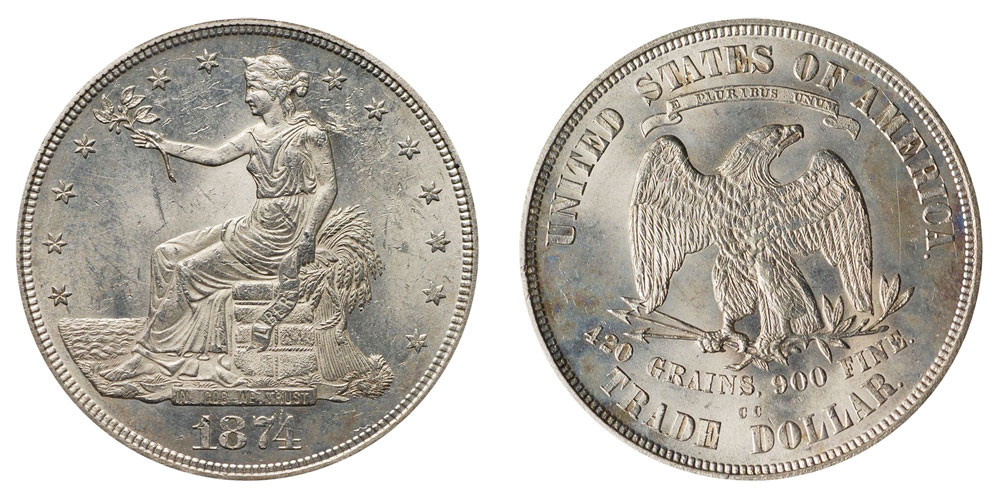
On February 25, 1863, President Abraham Lincoln signed the National Banking Act (originally known as the National Currency Act), which for the first time in American history established the federal dollar as the sole currency of the United States. On the law’s 150th anniversary, explore eight surprising facts about American money.


TIMELIME OF AMERICAN BILLS:
https://www.uscurrency.gov/content/history-american-currency


1. The Constitution only authorized the federal government to issue coins, not paper money.

Article One of the Constitution granted the federal government the sole power “to coin money” and “regulate the value thereof.” However, it said nothing about paper money. This was largely because the founding fathers had seen the bills issued by the Continental Congress to finance the American Revolution—called “continentals”—become virtually worthless by the end of the war. The implosion of the continental eroded faith in paper currency to such an extent that the Constitutional Convention delegates decided to remain silent on the issue.


2. Prior to the Civil War, banks printed paper money.

For America’s first 70 years, private entities, and not the federal government, issued paper money. Notes printed by state-chartered banks, which could be exchanged for gold and silver, were the most common form of paper currency in circulation. From the founding of the United States to the passage of the National Banking Act, some 8,000 different entities issued currency, which created an unwieldy money supply and facilitated rampant counterfeiting. By establishing a single national currency, the National Banking Act eliminated the overwhelming variety of paper money circulating throughout the country and created a system of banks chartered by the federal government rather than by the states. The law also assisted the federal government in financing the Civil War.


3. Foreign coins were once acceptable legal tender in the United States.

Before gold and silver were discovered in the West in the mid-1800s, the United States lacked a sufficient quantity of precious metals for minting coins. Thus, a 1793 law permitted Spanish dollars and other foreign coins to be part of the American monetary system. Foreign coins were not banned as legal tender until 1857.
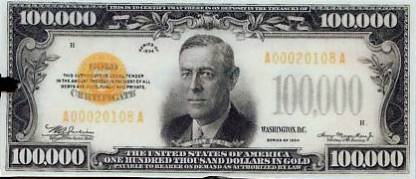


4. The highest-denomination note ever printed was worth $100,000.
The largest bill ever produced by the U.S. Bureau of Engraving and Printing was the $100,000 gold certificate. The currency notes were printed between December 18, 1934, and January 9, 1935, with the portrait of President Woodrow Wilson on the front. Don’t ask your bank teller for a $100,000 bill, though. The notes were never circulated to the public and were used solely for transactions among Federal Reserve banks.


5. You won’t find a president on the highest-denomination bill ever issued to the public.
The $10,000 bill is the highest denomination ever circulated by the federal government. In spite of its value, it is adorned not with a portrait of a president but with that of Salmon P. Chase, treasury secretary at the time of the passage of the National Banking Act. Chase later served as chief justice of the Supreme Court. The federal government stopped producing the $10,000 bill in 1969 along with these other high-end denominations: $5,000 (fronted by James Madison), $1,000 (fronted by Grover Cleveland) and $500 (fronted by William McKinley). (Although rare to find in your wallet, $2 bills are still printed periodically.)


6. Two American presidents appeared on Confederate dollars.

The Confederacy issued paper money worth approximately $1 billion during the Civil War—more than twice the amount circulated by the United States. While it’s not surprising that Confederate President Jefferson Davis and depictions of slaves at work in fields appeared on some dollar bills, so too did two Southern slave-holding presidents whom Confederates claimed as their own: George Washington (on a $50 and $100 bill) and Andrew Jackson (on a $1,000 bill).
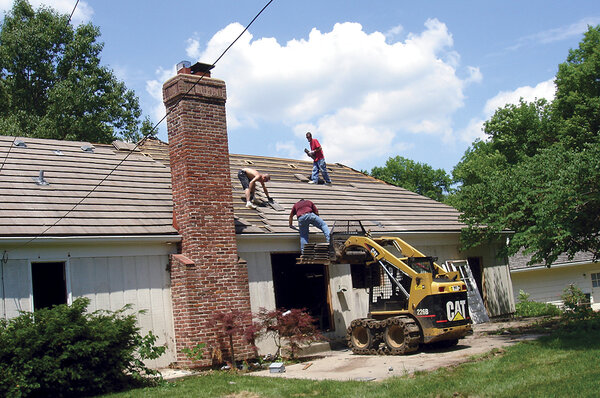


7. Your house may literally have been built with old money.
When dollar bills are taken out of circulation or become worn, they are shredded by Federal Reserve banks. In some cases, the federal government has sold the shredded currency to companies that can recycle it and use it for the production of building materials such as roofing shingles or insulation. (The Bureau of Engraving and Printing also sells small souvenir bags of shredded currency that was destroyed during the printing process.)


8. The $10 bill has the shortest lifespan of any denomination.

According to the Federal Reserve, the estimated lifespan of a $10 bill is 3.6 years. The estimated lifespans of a $5 and $1 bill are 3.8 years and 4.8 years, respectively. The highest estimated lifespan is for a $100 bill at nearly 18 years. The federal government reports that approximately 4,000 double folds (forward, then backward) are required to tear a note.

resource: http://www.history.com
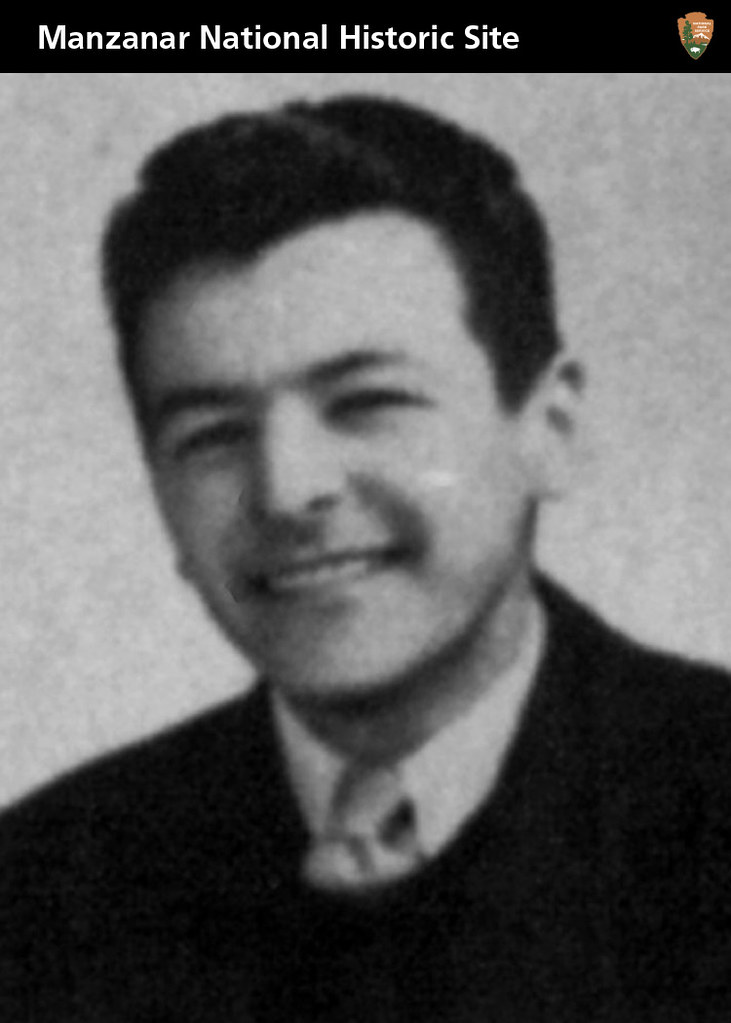
Following his beliefs: The Ralph Lazo Story

Tuesday, July 11, 2017

Following his beliefs led him to Manzanar
Ralph Lazo's decision to voluntarily join his Japanese American classmates in the internment camp still resonates 65 years later.
May 27, 2007|Cecilia Rasmussen | Times Staff Writerreprint: http://articles.latimes.com

Manzanar, Calif., May 1942.
It's a warm morning at the dusty, inhospitable World War II internment camp on the bleak edge of the Owens Valley. Latino teenager Ralph Lazo arrives by bus to join his Japanese American friends from Belmont High School. Lazo, a 16-year-old Mexican-Irish American, was motivated by loyalty and outrage at the internment of his friends. He became the only known non-spouse, non-Japanese who voluntarily relocated to Manzanar. "Who can say that I haven't got Japanese blood in my veins?" Lazo told The Times in a 1981 interview. That sentiment is voiced by actor Alexis Cruz , who plays Lazo in a 33-minute docudrama, "Stand Up for Justice: The Ralph Lazo Story." The film, which also uses archival footage, is part of a project to make local history and civics lessons more interesting for high school students.

The Los Angeles Unified School District recognized Lazo's act of friendship and loyalty last week as the Board of Education presented his relatives with a certificate for his contributions to the Japanese American community. Film participants, teachers and members of the Nikkei for Civil Rights and Redress group were also awarded certificates for the project, part of the board's Asian Pacific Heritage Month Resolution. Lazo was "an individual who showed courage. He stood up for his neighbors, doing the right thing at a difficult time," said John Esaki, who wrote and directed the film and is program director at the Japanese American National Museum in Little Tokyo. "This story has been told hundreds of times, but never through the eyes of a Mexican American. He was legendary, winning the hearts of everyone at Manzanar, and it was hard to ignore such a powerful and enduring character."

The film, made for about $100,000, was produced by Visual Communications, an Asian
Pacific media arts center, and funded by the California Civil Liberties Public Education Project. It recreates the period after Japan attacked Pearl Harbor on Dec. 7, 1941. More than two months later, on Feb. 19, 1942, President Roosevelt signed an executive order for the internment of 120,000 Japanese Americans on the West Coast, believing them to be a threat to national security.

Lazo, who was born in Los Angeles in 1925, grew up in the Temple Street neighborhood on Bunker Hill, a melting pot of Japanese, Basques, Jews, Latinos, Anglos, Filipinos, Koreans and African Americans. As he watched posters go up in community churches giving instructions for the internment process, "it really hit home," he told The Times in 1981. Anger overwhelmed him as he helped his friends hurriedly sell their belongings for a pittance. "Internment was immoral," he said. "It was wrong, and I couldn't accept it."

His father, John Houston Lazo, was a widower who supported Ralph and his sister, Virginia, by working for the Santa Fe Railroad and painting houses. When his father was on the road, Ralph Lazo often ate at the homes of Nisei friends -- second-generation Japanese Americans. He also played basketball on a Filipino community church team.  In May 1942, prodded by Japanese American classmates "to come along," Lazo slipped aboard a train. He'd told his father that he was going to camp with his Japanese American friends but was vague about the particulars. "I think he thought I meant weekend camp," Lazo told The Times. But when his father learned that his son was at Manzanar, he made no effort to bring him home. "He was a wise man," Lazo said. "He knew I was safe."

No government official asked about his ancestry, he said. "Being brown has its advantages." Despite Manzanar's name, Spanish for "apple orchard," the area had been left barren decades earlier when Owens Valley water was diverted to Los Angeles. But Lazo helped to make the place as attractive as possible by planting trees. He also delivered mail and kept spirits up by holding holiday parties that featured punch, deviled-egg sandwiches and the Jive Bombers, the camp's dance band. He even played cupid, matchmaking several friends, according to Esaki, the filmmaker. "He was enthusiastic. He spoke a little Japanese and was a cheerleader who fired up the crowd at all the sporting events," Esaki said. Lazo told The Times that camp inmates tried to make the best of their situation. "We didn't just sit around and complain," he said. "In the summer, the heat was unbearable; in the winter, the sparsely rationed oil didn't adequately heat the tarpaper-covered pine barracks with the knotholes in the floor. The wind would blow so hard, it would toss rocks around."

When everything looked grim, Toyo Miyatake, a renowned photographer who captured poignant scenes at Manzanar with his contraband homemade camera, "would always point out the beauty around us," Lazo said. In 1944, Lazo was elected class president of Manzanar High School, even though he graduated at the bottom of a class of 150. "I didn't mind being at the bottom of that group," he told The Times.  Government officials finally realized Lazo was not Japanese-American when he was drafted in August 1944. The U.S. Department of the Interior's War Relocation Authority touted the fact with a news release: "America's only non-Japanese evacuee, Ralph Lazo In fact, there were other non-Japanese at internment camps -- spouses of Japanese Americans and Japanese citizens.

Army Staff Sgt. Lazo served in the South Pacific during the campaign for the liberation of the Philippines. "The American G.I. couldn't tell the difference between a Japanese and a Filipino. That's why they assigned me." Soldiers "were killing the Filipinos and letting the Japanese go," he told The Times. He was awarded a Bronze Star for heroism in combat. After the war, Lazo graduated from UCLA and earned a master's degree from Cal State Northridge. He became a teacher and joined the struggle to win reparations for Japanese Americans, helping raise funds for a threatened class-action lawsuit. In 1988, Congress passed a law to award each surviving internee $20,000.

Lazo taught at San Fernando Junior High School, then at Grant and Monroe high schools before becoming a counselor at Valley College in 1970. There, he also mentored students who were disabled and worked to persuade more Latino parents to encourage their children to go to college and register to vote.


Dolores Huerta: Activist

Thursday, July 6, 2017

“Every moment is an organizing opportunity, every person a potential activist, every minute a chance to change the world.”
—Dolores Huerta

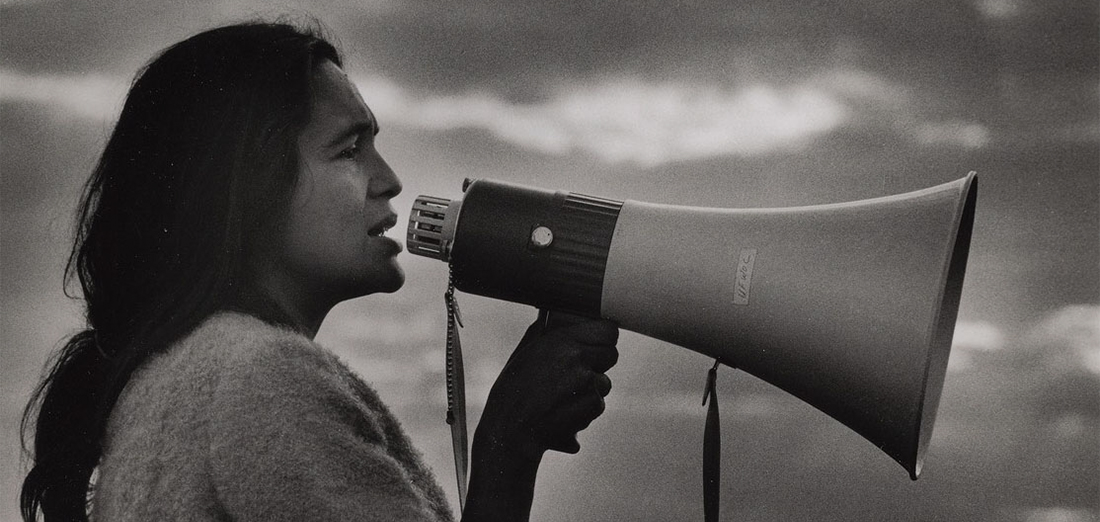
Dolores Huerta has worked to improve social and economic conditions for farm workers and to fight discrimination. To further her cause, she created the Agricultural Workers Association (AWA) in 1960 and co-founded what would become the United Farm Workers (UFW). Huerta stepped down from the UFW in 1999, but she continues her efforts to improve the lives of workers, immigrants and women.

Early Life 

Activist and labor leader Dolores Fernández, better known as Dolores Huerta, was born April 10, 1930, in Dawson, New Mexico, the second child of Juan and Alicia (Chavez) Fernandez. The young family struggled, and by the time Dolores was three, her parents divorced and her mother moved Dolores and her two brothers to Stockton, California. Dolores maintained a relationship with her father, who later became a union activist and a New Mexico state assemblyman. Juan’s own political and labor activism later proved inspirational to Dolores.

Migrant Workers in Stockton, CA
When the family first arrived in Stockton, a farming community in the San Joaquin Valley, Alicia worked two jobs to provide for the family. Dolores’s grandfather, Herculano Chavez, took care of the children, serving as the children’s adult male figure. Dolores admired her mother, who was always encouraged her children to get involved in youth activities and become something. Alicia worked hard to provide music lessons and extracurricular activities for Dolores and her brothers. Dolores played violin and piano and took dance lessons. A good student, she was also a Girl Scout up until she turned 18, and she won second place in a national essay contest.

Despite her achievements, Dolores experienced the racism many Mexicans and Mexican Americans suffered from, especially those who were farm workers. At school she was sometimes treated with suspicion and scorn. She was once accused by a teacher of stealing another student’s work because the teacher was convinced that Dolores was incapable, due to her ethnic origin. However, with time, her family’s economic conditions improved. During World War II, Alicia ran a restaurant and then purchased a hotel in Stockton with her second husband, James Richards. The businesses served the farm workers and day laborers, offering affordable rates and welcoming the diversity of the area.

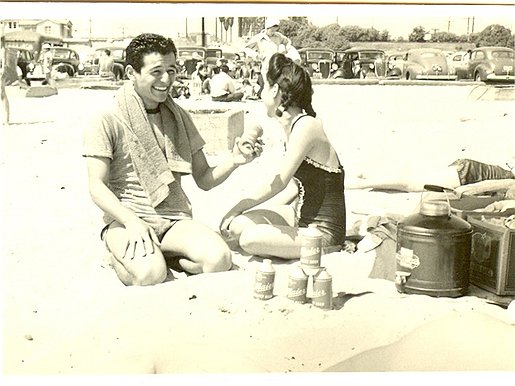
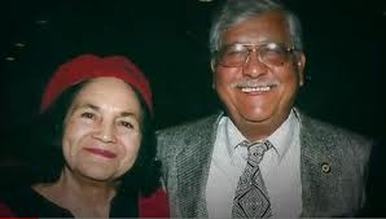
Dolores with her husband, Ventura
After graduating from Stockton High School, in 1947, Dolores Fernandez went through a marriage, the birth to two children and a divorce. After a series of unsatisfying jobs, she returned to school and eventually completed a teaching degree at Stockton College, part of the University of the Pacific. She briefly worked as an elementary school teacher, but resigned because she was so distraught over the poor living conditions of her students, many of them children of farm workers. Determined to help, in 1955, she and Fred Ross started the Stockton chapter of the Community Services Organization (CSO), a grassroots group that worked to end segregation, discrimination and police brutality and improve social and economic conditions of farm workers. During this time, Dolores married Ventura Huerta, another labor activist. The couple would go on to have five children.

A Life of Activism

Cesar Chavez
In 1960, Dolores Huerta started the Agricultural Workers Association (AWA). She set up voter registration drives and lobbied politicians to allow non–U.S. citizen migrant workers to receive public assistance and pensions and provide Spanish-language voting ballots and driver's tests. During this time, Dolores met Cesar Chavez, a fellow CSO official, who had become its director. In 1962, both Huerta and Chavez lobbied to have the CSO expand its efforts to help farm workers, but the organization was focused on urban issues and couldn’t move in that direction. Frustrated, they both left the organization and, with Gilbert Padilla, co-founded the National Farm Workers Association (NFWA). The two made a great team. Chavez was the dynamic leader and speaker; and Huerta the skilled organizer and tough negotiator.

In 1965, the AWA and the NFWA combined to become the United Farm Workers Organizing Committee (later, simply the United Farm Workers). That year, the union took on the Coachella Valley grape growers, with Chavez organizing a strike of all farm workers and Huerta negotiating contracts. After five hard years, the United Farm Workers (now affiliated with the American Federation of Labor and Congress of Industrial Organizations) signed an historic agreement with 26 grape growers that improved working conditions for farm workers, including reducing the use of harmful pesticides and initiating unemployment and healthcare benefits. In the 1970s, Huerta coordinated a national lettuce boycott and helped create the political climate for the passage of the 1975 Agricultural Labor Relations Act, the first law to recognize the rights of farm workers to bargain collectively.

During the 1980s, Dolores Huerta served as vice president of the UFW and co-founded the UFW’s radio station. She continued to speak for a variety of causes, advocating for a comprehensive immigration policy and better health conditions for farm workers. In 1988, she nearly lost her life when she was beaten by San Francisco police at a rally protesting the policies of then-presidential candidate George H. W. Bush. She suffered six broken ribs and a ruptured spleen.

Later Life

Dolores Huerta has been honored for her work as a fierce advocate for farm workers, immigration and women. She received the Ellis Island Medal of Freedom Award and was inducted in the National Women’s Hall of Fame in 1993. That year proved bitter-sweet for her as she also experienced the passing of her beloved friend Cesar Chavez. In 1998, she received the Eleanor Roosevelt Award, a year before she stepped down from her position at the United Farm Workers. In 2002, she received the Puffin/Nation Prize for Creative Citizenship. The $100,000 award provided her the means to create the Dolores Huerta Foundation, whose purpose is to bring organizing and training skills to low-income communities. Huerta continues to lecture and speak out on a variety of social issues involving immigration, income inequality and the rights of women and Latinos.  

Resource: www.biography.com


In 2006, Dolores Huerta visits Tucson High School and makes a speech. Within the speech, she states "Republicans Hate Latinos." In 2010, Arizona Attorney Tom Horne and other politicians used these words as their rationale for passing HB-2281-The Ethnic Studies Ban. In this interview, Dolores Huerta discusses the statement and its affect. 

more about Latino History: rudyacuna.net

So, what's so important about the month of February?

Saturday, January 31, 2015

Other than Valentine's Day, just what in the heck is so special about the month of February? There are only 28 days and it's in the middle of winter.  Let's take a recap on American history:

Feb. 1

_________________________________________________________________________
Feb. 2

_________________________________________________________________________
Feb. 3


_________________________________________________________________________
Feb. 4


_________________________________________________________________________
Feb. 5


_________________________________________________________________________
Feb. 6


_________________________________________________________________________

Feb. 7

_________________________________________________________________________
Feb. 8

_________________________________________________________________________
Feb. 9


_________________________________________________________________________

Feb. 10

_________________________________________________________________________
Feb. 11

_________________________________________________________________________
Jan. 12

_________________________________________________________________________
Feb. 13

_________________________________________________________________________
Feb. 14

  • 2005 – YouTube is launched by a group of college students, eventually becoming the largest video sharing website in the world and a main source for viral videos.
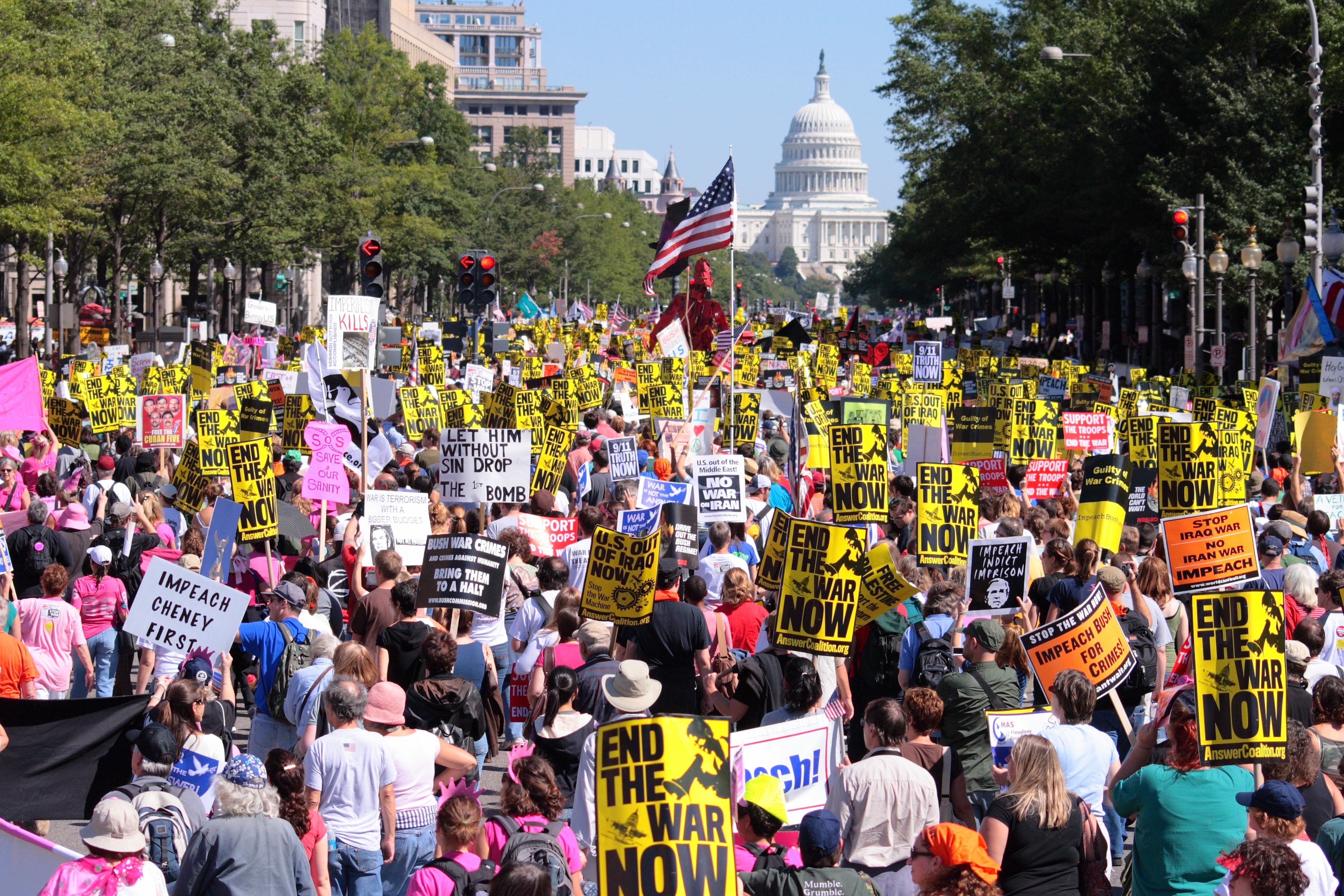
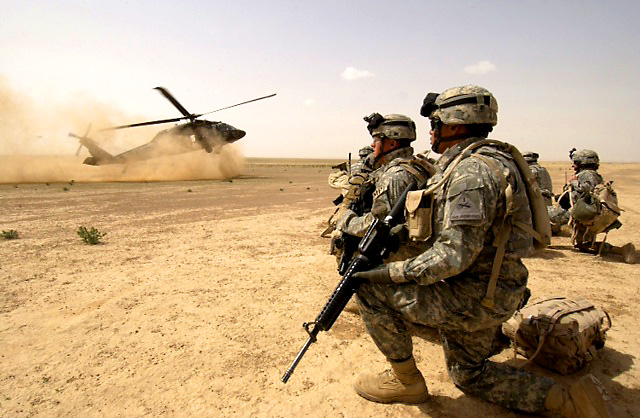
  • 2003  Protests against the Iraq war take place in over 600 cities worldwide. It is estimated that between 8 million to 30 million people participate, making this the largest peace demonstration in history.
    ________
    ____________________________________________________________

    Feb. 16
_________________________________________________________________________
Feb. 17

_________________________________________________________________________
Feb. 18

_________________________________________________________________________
Feb. 19

_________________________________________________________________________
Feb. 20

_________________________________________________________________________
Feb. 21

_________________________________________________________________________
Feb. 22

_________________________________________________________________________
Feb. 23

_________________________________________________________________________
Feb. 24

_________________________________________________________________________
Feb. 25

_________________________________________________________________________
Feb. 26

_________________________________________________________________________
Feb. 27

_________________________________________________________________________
Feb. 28