Contrary to popular perception, the Old West was much more peaceful than American cities are today. The real culture of violence on the frontier during the latter half of the nineteenth century sprang from the U.S. government’s policies toward the Plains Indians.
The Not-So-Wild, Wild West

In a thorough review of the “West was violent” literature, Bruce Benson (1998) discovered that many historians simply assume that violence was pervasive—even more so than in modern-day America—and then theorize about its likely causes. In addition, some authors assume that the West was very violent and then assert, as Joe Franz does, that “American violence today reflects our frontier heritage” (Franz 1969, qtd. in Benson 1998, 98). Thus, an allegedly violent and stateless society of the nineteenth century is blamed for at least some of the violence in the United States today.
In a book-length survey of the “West was violent” literature, historian Roger McGrath echoes Benson’s skepticism about this theory when he writes that “the frontier-was-violent authors are not, for the most part, attempting to prove that the frontier was violent. Rather, they assume that it was violent and then proffer explanations for that alleged violence” (1984, 270).
In contrast, an alternative literature based on actual history concludes that the civil society of the American West in the nineteenth century was not very violent. Eugene Hollon writes that the western frontier “was a far more civilized, more peaceful and safer place than American society today” (1974, x). Terry Anderson and P. J. Hill affirm that although “[t]he West . . . is perceived as a place of great chaos, with little respect for property or life,” their research “indicates that this was not the case; property rights were protected and civil order prevailed. Private agencies provided the necessary basis for an orderly society in which property was protected and conflicts were resolved” (1979, 10).
What were these private protective agencies? They were not governments because they did not have a legal monopoly on keeping order. Instead, they included such organizations as land clubs, cattlemen’s associations, mining camps, and wagon trains.
So-called land clubs were organizations established by settlers before the U.S. government even surveyed the land, let alone started to sell it or give it away. Because disputes over land titles are inevitable, the land clubs adopted their own constitutions, laying out the “laws” that would define and protect property rights in land (Anderson and Hill 1979, 15). They administered land claims, protected them from outsiders, and arbitrated disputes. Social ostracism was used effectively against those who violated the rules. Establishing property rights in this way minimized disputes—and violence.
The wagon trains that transported thousands of people to the California gold fields and other parts of the West usually established their own constitutions before setting out. These constitutions often included detailed judicial systems. As a consequence, writes Benson, “[t]here were few instances of violence on the wagon trains even when food became extremely scarce and starvation threatened. When crimes against persons or their property were committed, the judicial system . . . would take effect” (1998, 102). Ostracism and threats of banishment from the group, instead of threats of violence, were usually sufficient to correct rule breakers’ behavior.
Dozens of movies have portrayed the nineteenth-century mining camps in the West as hot beds of anarchy and violence, but John Umbeck discovered that, beginning in 1848, the miners began forming contracts with one another to restrain their own behavior (1981, 51). There was no government authority in California at the time, apart from a few military posts. The miners’ contracts established property rights in land (and in any gold found on the land) that the miners themselves enforced. Miners who did not accept the rules the majority adopted were free to mine elsewhere or to set up their own contractual arrangements with other miners. The rules that were adopted were often consequently established with unanimous consent (Anderson and Hill 1979, 19). As long as a miner abided by the rules, the other miners defended his rights under the community contract. If he did not abide by the agreed-on rules, his claim would be regarded as “open to any [claim] jumpers” (Umbeck 1981, 53).

The mining camps hired “enforcement specialists”—justices of the peace and arbitrators—and developed an extensive body of property and criminal law. As a result, there was very little violence and theft. The fact that the miners were usually armed also helps to explain why crime was relatively infrequent. Benson concludes, “The contractual system of law effectively generated cooperation rather than conflict, and on those occasions when conflict arose it was, by and large, effectively quelled through nonviolent means” (1998, 105).
When government bureaucrats failed to police cattle rustling effectively, ranchers established cattlemen’s associations that drew up their own constitutions and hired private “protection agencies” that were often staffed by expert gunmen. This action deterred cattle rustling. Some of these “gunmen” did “drift in and out of a life of crime,” write Anderson and Hill (1979, 18), but they were usually dealt with by the cattlemen’s associations and never created any kind of large-scale criminal organization, as some have predicted would occur under a regime of private law enforcement.
In sum, this work by Benson, Anderson and Hill, Umbeck, and others challenges with solid historical research the claims made by the “West was violent” authors. The civil society of the American West in the nineteenth century was much more peaceful than American cities are today, and the evidence suggests that in fact the Old West was not a very violent place at all. History also reveals that the expanded presence of the U.S. government was the real cause of a culture of violence in the American West. If there is anything to the idea that a nineteenth-century culture of violence on the American frontier is the genesis of much of the violence in the United States today, the main source of that culture is therefore government, not civil society.
The Real Cause of Violence in the American West
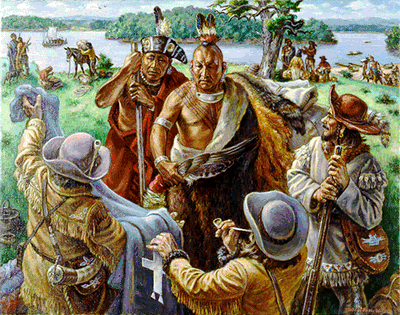
The real culture of violence in the American West of the latter half of the nineteenth century sprang from the U.S. government’s policies toward the Plains Indians. It is untrue that white European settlers were always at war with Indians, as popular folklore contends. After all, Indians assisted the Pilgrims and celebrated the first Thanksgiving with them; John Smith married Pocahontas; a white man (mostly Scots, with some Cherokee), John Ross, was the chief of the Cherokees of Tennessee and North Carolina; and there was always a great deal of trade with Indians, as opposed to violence. As Jennifer Roback has written, “Europeans generally acknowledged that the Indians retained possessory rights to their lands. More important, the English recognized the advantage of being on friendly terms with the Indians. Trade with the Indians, especially the fur trade, was profitable. War was costly” (1992, 9). Trade and cooperation with the Indians were much more common than conflict and violence during the first half of the nineteenth century.
Terry Anderson and Fred McChesney relate how Thomas Jefferson found that during his time negotiation was the Europeans’ predominant means of acquiring land from Indians (1994, 56). By the twentieth century, some $800 million had been paid for Indian lands. These authors also argue that various factors can alter the incentives for trade, as opposed to waging a war of conquest as a means of acquiring land. One of the most important factors is the existence of a standing army, as opposed to militias, which were used in the American West prior to the War Between the States. On this point, Anderson and McChesney quote Adam Smith, who wrote that “‘[i]n a militia, the character of the labourer, artificer, or tradesman, predominates over that of the soldier: in a standing army, that of the soldier predominates over every other character.’” (1994, 52). A standing army, according to Anderson and McChesney, “creates a class of professional soldiers whose personal welfare increases with warfare, even if fighting is a negative-sum act for the population as a whole” (52).
The change from militia to a standing army took place in the American West immediately upon the conclusion of the War Between the States. The result, say Anderson and McChesney, was that white settlers and railroad corporations were able to socialize the costs of stealing Indian lands by using violence supplied by the U.S. Army. On their own, they were much more likely to negotiate peacefully. Thus, “raid” replaced “trade” in white–Indian relations. Congress even voted in 1871 not to ratify any more Indian treaties, effectively announcing that it no longer sought peaceful relations with the Plains Indians. Anderson and McChesney do not consider why a standing army replaced militias in 1865, but the reason is not difficult to discern. One has only to read the official pronouncements of the soldiers and political figures who launched a campaign of extermination against the Plains Indians.
On June 27, 1865, General William Tecumseh Sherman was given command of the Military District of the Missouri, which was one of the five military divisions into which the U.S. government had divided the country. Sherman received this command for the purpose of commencing the twenty-five-year war against the Plains Indians, primarily as a form of veiled subsidy to the government-subsidized railroad corporations and other politically connected corporations involved in building the transcontinental railroads. These corporations were the financial backbone of the Republican Party. Indeed, in June 1861, Abraham Lincoln, former legal counsel of the Illinois Central Railroad, called a special emergency session of Congress not to deal with the two-month-old Civil War, but to commence work on the Pacific Railway Act. Subsidizing the transcontinental railroads was a primary (if not the primary) objective of the new Republican Party. As Dee Brown writes in Hear That Lonesome Whistle Blow, a history of the building of the transcontinental railroads, Lincoln’s 1862 Pacific Railway Act “assured the fortunes of a dynasty of American families . . . the Brewsters, Bushnells, Olcotts, Harkers, Harrisons, Trowbridges, Lanworthys, Reids, Ogdens, Bradfords, Noyeses, Brooks, Cornells, and dozens of others” (2001, 49), all of whom were tied to the Republican Party.
The federal railroad subsidies enriched many Republican members of Congress. Congressman Thaddeus Stevens of Pennsylvania “received a block of [Union Pacific] stock in exchange for his vote” on the Pacific Railroad bill, writes Brown (2001, 58). The Pennsylvania iron manufacturer and congressman also demanded a legal requirement that all iron used in constructing the railroad be made in the United States. Republican congressman Oakes Ames of Massachusetts was a shovel manufacturer who became “a loyal ally” of the legislation after he was promised shovel contracts (Brown 2001, 58). A great many shovels must have been required to dig railroad beds from Iowa to California.
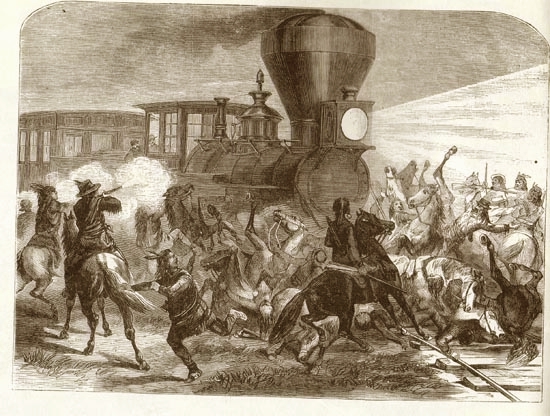
Sherman wrote in his memoirs that as soon as the war ended, “My thoughts and feelings at once reverted to the construction of the great Pacific Railway. . . . I put myself in communication with the parties engaged in the work, visiting them in person, and assured them that I would afford them all possible assistance and encouragement” (2005, 775). “We are not going to let a few thieving, ragged Indians check and stop the progress [of the railroads],” Sherman wrote to Ulysses S. Grant in 1867 (qtd. in Fellman 1995, 264).
The chief engineer of the government-subsidized transcontinental railroads was Grenville Dodge, another of Lincoln’s generals during the war with whom Sherman worked closely afterward. As Murray Rothbard points out, Dodge “helped swing the Iowa delegation to Lincoln” at the 1860 Republican National Convention, and “[i]n return, early in the Civil War, Lincoln appointed Dodge to army general. Dodge’s task was to clear the Indians from the designated path of the country’s first heavily subsidized federally chartered trans-continental railroad, the Union Pacific.” In this way, Rothbard concludes, “conscripted Union troops and hapless taxpayers were coerced into socializing the costs of constructing and operating the Union Pacific” (1997, 130).
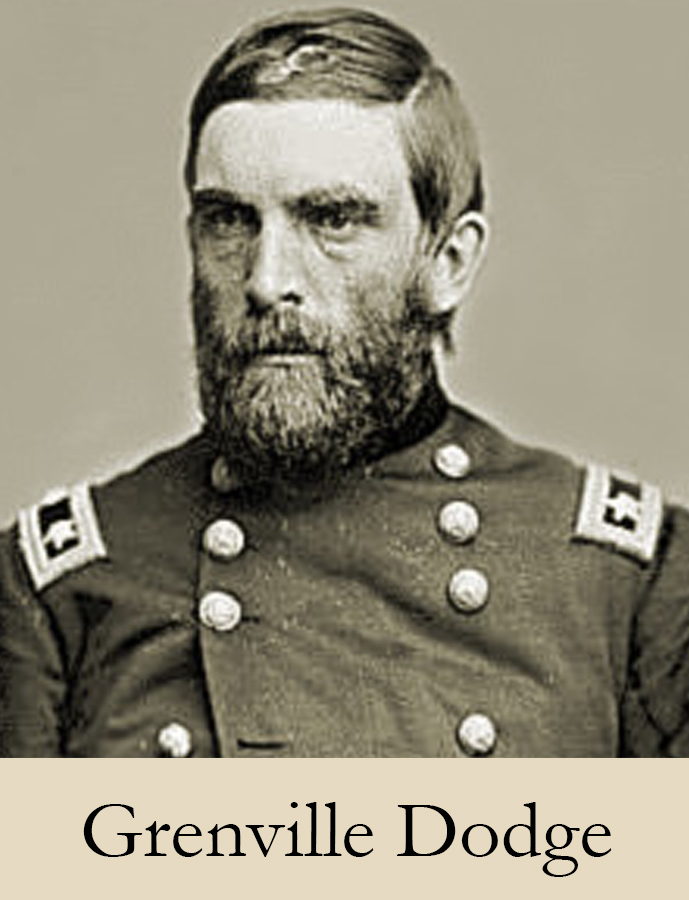
Immediately after the war, Dodge proposed enslaving the Plains Indians and forcing them “to do the grading” on the railroad beds, “with the Army furnishing a guard to make the Indians work, and keep them from running away” (Brown 2001, 64). Union army veterans were to be the “overseers” of this new class of slaves. Dodge’s proposal was rejected; the U.S. government decided instead to try to kill as many Indians as possible.
In his memoirs, Sherman has high praise for Thomas Clark Durant, the vice president of the Union Pacific Railroad, as “a person of ardent nature, of great ability and energy, enthusiastic in his undertaking” (2005, 775). Durant was also the chief instigator of the infamous Credit Mobilier scandal, one of the most shocking examples of political corruption in U.S. history. Sherman himself had invested in railroads before the war, and he was a consummate political insider, along with Durant, Dodge, and his brother, Senator John Sherman.
President Grant made his old friend Sherman the army’s commanding general, and another Civil War luminary, General Phillip Sheridan, assumed command on the ground in the West. “Thus the great triumvirate of the Union Civil War effort,” writes Sherman biographer Michael Fellman, “formulated and enacted military Indian policy until reaching, by the 1880s, what Sherman sometimes referred to as ‘the final solution of the Indian problem’” (1995, 260).
What Sherman called the “final solution of the Indian problem” involved “killing hostile Indians and segregating their pauperized survivors in remote places.” “These men,” writes Fellman, “applied their shared ruthlessness, born of their Civil War experiences, against a people all three [men] despised. . . . Sherman’s overall policy was never accommodation and compromise, but vigorous war against the Indians,” whom he regarded as “a less-than-human and savage race” (1995, 260).
All of the other generals who took part in the Indian Wars were “like Sherman [and Sheridan], Civil War luminaries,” writes Sherman biographer John Marszalek. “Their names were familiar from Civil War battles: John Pope, O. O. Howard, Nelson A. Miles, Alfred H. Terry, E. O. C. Ord, C. C. Augur . . . Edward Canby . . . George Armstrong Custer and Benjamin Garrison” (1993, 380). General Winfield Scott Hancock also belongs on this list.
Sherman and Sheridan’s biographers frequently point out that these men apparently viewed the Indian Wars as a continuation of the job they had performed during the Civil War. “Sherman viewed Indians as he viewed recalcitrant Southerners during the war and newly freed people after: resisters to the legitimate forces of an ordered society” (Marszalek 1993, 380). Marszalek might well have written also that Southerners, former slaves, and Indians were not so much opposed to an “ordered society,” but to being ordered around by politicians in Washington, D.C., primarily for the benefit of the politicians’ corporate benefactors.

“During the Civil War, Sherman and Sheridan had practiced a total war of destruction of property. . . . Now the army, in its Indian warfare, often wiped out entire villages” (Marszalek 1993, 382). Fellman writes that Sherman charged Sheridan “to act with all the vigor he had shown in the Shenandoah Valley during the final months of the Civil War” (1995, 270). Sheridan’s troops had burned and plundered the Shenandoah Valley after the Confederate army had evacuated the area and only women, children, and elderly men remained there (Morris 1992, 183). Even Prussian army officers are said to have been shocked when after the war Sheridan boasted to them of his exploits in the Shenandoah Valley. “[Sherman] insisted that the only answer to the Indian problem was all-out war—of the kind he had utilized against the Confederacy,” writes Marszalek. “Since the inferior Indians refused to step aside so superior American culture could create success and progress, they had to be driven out of the way as the Confederates had been driven back into the Union” (1993, 380).
Sherman’s compulsion for the “extermination” of anyone opposed to turning the U.S. state into an empire expressed the same reasoning he had expressed earlier with regard to his role in the War Between the States. In a letter to his wife early in the war, he declared that his ultimate purpose was “extermination, not of soldiers alone, that is the least part of the trouble, but the people.” Mrs. Sherman responded by expressing her similar wish that the conflict would be a “war of extermination, and that all [Southerners] would be driven like the swine into the sea. May we carry fire and sword into their states till not one habitation is left standing” (qtd. in Walters 1973, 61). Sherman did his best to take his wife’s advice, especially during his famous “march to the sea.” It is little wonder that Indian Wars historian S. L. A. Marshall observes, “[M]ost of the Plains Indian bands were in sympathy with the Southern cause” during the war (1972, 24).
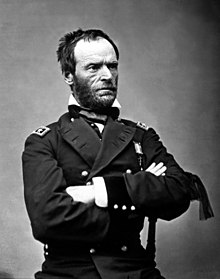 |
| General Sherman |
One theme among all of these Union Civil War veterans is that they considered Indians to be subhuman and racially inferior to whites and therefore deserving of extermination if they could not be “controlled” by the white population. Sherman himself thought of the former slaves in exactly the same way. “The Indians give a fair illustration of the fate of the negroes if they are released from the control of the whites,” he once said (qtd. in Kennett 2001, 296). He believed that intermarriage of whites and Indians would be disastrous, as he claimed it was in New Mexico, where “the blending of races had produced general equality, which led inevitably to Mexican anarchy” (qtd. in Kennett 2001, 297).
Sherman described the inhabitants of New Mexico, many of whom were part Mexican (Spanish), part Indian, and part Negro, as “mongrels.” His goal was to eliminate the possibility that such racial amalgamation might occur elsewhere in the United States, by undertaking to effect what Michael Fellman called a “racial cleansing of the land” (1995, 264), beginning with extermination of the Indians.
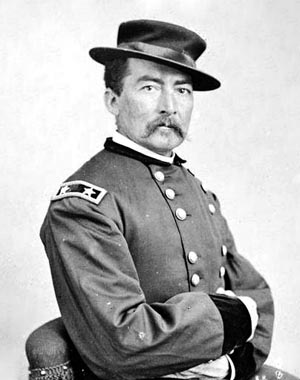 |
| General Sheridan |
Sherman, Sheridan, and the other top military commanders were not shy about announcing that their objective was extermination, a term that Sherman used literally on a number of occasions, as he had in reference to Southerners only a few years earlier. He and Sheridan are forever associated with the slogan “the only good Indian is a dead Indian.” “All the Indians will have to be killed or be maintained as a species of paupers,” he said. Sherman announced his objective as being “to prosecute the war with vindictive earnestness . . . till [the Indians] are obliterated or beg for mercy” (qtd. in Fellman 1995, 270). According to Fellman, Sherman gave “Sheridan prior authorization to slaughter as many women and children as well as men Sheridan or his subordinates felt was necessary when they attacked Indian villages” (1995, 271).
In case the media back east got wind of such atrocities, Sherman promised Sheridan that he would run interference against any complaints: “I will back you with my whole authority, and stand between you and any efforts that may be attempted in your rear to restrain your purpose or check your troops” (qtd. in Fellman 1995, 271). In later correspondence, Sherman wrote to Sheridan, “I am charmed at the handsome conduct of our troops in the field. They go in with the relish that used to make our hearts glad in 1864–5” (qtd. in Fellman 1995, 272).
Sherman and Sheridan’s troops conducted more than one thousand attacks on Indian villages, mostly in the winter months, when families were together. The U.S. army’s actions matched its leaders’ rhetoric of extermination. As mentioned earlier, Sherman gave orders to kill everyone and everything, including dogs, and to burn everything that would burn so as to increase the likelihood that any survivors would starve or freeze to death. The soldiers also waged a war of extermination on the buffalo, which was the Indians’ chief source of food, winter clothing, and other goods (the Indians even made fish hooks out of dried buffalo bones and bow strings out of sinews).

By 1882, the buffalo were all but extinct, and the cause was not just the tragedy of the commons. Because buffalo hides could be sold for as much as $3.50 each, an individual hunter would kill more than a hundred a day for as many days as he cared to hunt on the open plain. This exploitation of a “common property resource” decimated the buffalo herds, but the decimation was also an integral part of U.S. military policy aimed at starving the Plains Indians. When a group of Texans asked Sheridan if he could not do something to stop the extermination of the buffalo, he said: “Let them kill, skin, and sell until the buffalo is exterminated, as it is the only way to bring lasting peace and allow civilization to advance” (qtd. in Brown 1970, 265).
The escalation of violence against the Plains Indians actually began in earnest during the War Between the States. Sherman and Sheridan’s Indian policy was a continuation and escalation of a policy that General Grenville Dodge, among others, had already commenced. In 1851, the Santee Sioux Indians in Minnesota sold 24 million acres of land to the U.S. government for $1,410,000 in a typical “trade” (as opposed to raid) scenario. The federal government once again did not keep its side of the bargain, though, reneging on its payment to the Indians (Nichols 1978). By 1862, thousands of white settlers were moving onto the Indians’ land, and a crop failure in that year caused the Santee Sioux to become desperate for food. They attempted to take back their land by force with a short “war” in which President Lincoln placed General John Pope in charge. Pope announced, “It is my purpose to utterly exterminate the Sioux. . . . They are to be treated as maniacs or wild beasts, and by no means as people with whom treaties or compromises can be made” (qtd. in Nichols 1978, 87).
At the end of the month-long conflict, hundreds of Indians who had been taken prisoner were subjected to military “trials” lasting about ten minutes each, according to Nichols (1978). Most of the adult male prisoners were found guilty and sentenced to death—not based on evidence of the commission of a crime, but on their mere presence at the end of the fighting. Minnesota authorities wanted to execute all 303 who were convicted, but the Lincoln administration feared that the European powers would not view such an act favorably and did not want to give them an excuse to assist the Confederacy in any way. Therefore, “only” 38 of the Indians were hanged, making this travesty of justice still the largest mass execution in U.S. history (Nichols 1978). To appease the Minnesotans who wanted to execute all 303, Lincoln promised them $2 million and pledged that the U.S. Army would remove all Indians from the state at some future date.
One of the most famous incidents of Indian extermination, known as the Sand Creek Massacre, took place on November 29, 1864. There was a Cheyenne and Arapaho village located on Sand Creek in southeastern Colorado. These Indians had been assured by the U.S. government that they would be safe in Colorado. The government instructed them to fly a U.S. flag over their village, which they did, to assure their safety. However, another Civil War “luminary,” Colonel John Chivington, had other plans for them as he raided the village with 750 heavily armed soldiers. One account of what happened appears in the book Crimsoned Prairie: The Indian Wars (1972) by the renowned military historian S. L. A. Marshall, who held the title of chief historian of the European Theater in World War II and authored thirty books on American military history.
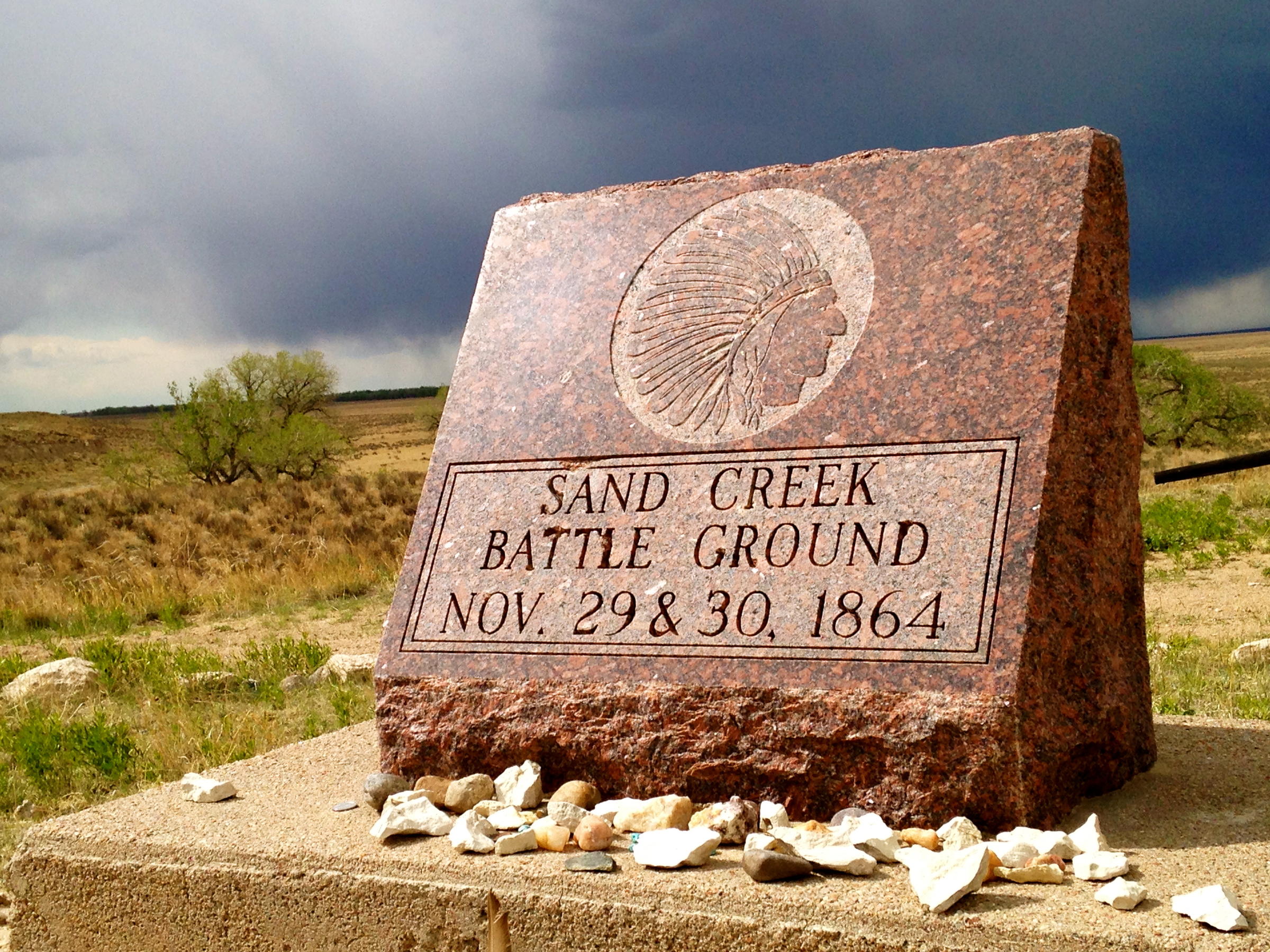
Chivington’s orders were: “I want you to kill and scalp all, big and little; nits make lice” (qtd. in Marshall 1972, 37). Then, despite the display of the U.S. flag and white surrender flags by these peaceful Indians, Chivington’s troops “began a full day given over to blood-lust, orgiastic mutilation, rapine, and destruction—with Chivington . . . looking on and approving” (Marshall 1972, 38). Marshall notes that the most reliable estimate of the number of Indians killed is “163, of which 110 were women and children” (39).
Upon returning to his fort, Chivington “and his raiders demonstrated around Denver, waving their trophies, more than one hundred drying scalps. They were acclaimed as conquering heroes, which was what they had sought mainly.” One Republican Party newspaper announced, “Colorado soldiers have once again covered themselves with glory” (qtd. in Marshall 1972, 39).
An even more detailed account of the Sand Creek Massacre, based on U.S. Army records, biographies, and firsthand accounts, appears in Dee Brown’s classic Bury My Heart at Wounded Knee: An Indian History of the American West: “When the troops came up to [the squaws,] they ran out and showed their persons to let the soldiers know they were squaws and begged for mercy, but the soldiers shot them all. . . . There seemed to be indiscriminate slaughter of men, women and children. . . .The squaws offered no resistance. Every one . . . was scalped” (1970, 89). Brown’s narrative gets much more graphic. The effect of such behavior was to eliminate forever the possibility of peaceful relations with these Indian tribes. They understood that they had become the objects of a campaign of extermination. As Brown writes, “In a few hours of madness at Sand Creek, Chivington and his soldiers destroyed the lives or the power of every Cheyenne and Arapaho chief who had held out for peace with the white men” (92). For the next two decades, the Plains Indians would do their best to return the barbarism in kind.
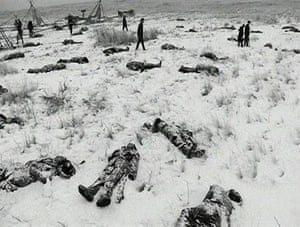 |
| Wounded Knee |
The books by Brown and Marshall show that the kind of barbarism that occurred at Sand Creek, Colorado, was repeated many times during the next two decades. For example, in 1868 General Winfield Scott Hancock ordered Custer to attack a Cheyenne camp with infantry, which Custer did. The attack led Superintendent of Indian Affairs Thomas Murphy to report to Washington that “General Hancock’s expedition . . . has resulted in no good, but, on the contrary, has been productive of much evil” (qtd. in Brown 1970, 157). A report of the attack prepared for the U.S. secretary of the interior concluded: “For a mighty nation like us to be carrying on a war with a few straggling nomads, under such circumstances, is a spectacle most humiliating, and injustice unparalleled, a national crime most revolting, that must, sooner or later, bring down upon us or our posterity the judgment of Heaven” (qtd. in Brown 1970, 157).
As the war on the Cheyenne continued, Custer and his troops apparently decided that to “kill or hang all the warriors,” as General Sheridan had ordered, “meant separating them from the old men, women, and children. This work was too slow and dangerous for the cavalrymen; they found it much more efficient and safe to kill indiscriminately. They killed 103 Cheyenne, but only eleven of them were warriors” (Brown 1970, 169).
Marshall calls Sheridan’s orders to Custer “the most brutal orders ever published to American troops” (1972, 106). This is a powerful statement coming from a man who wrote thirty books on American military history. In addition to ordering Custer to shoot or hang all warriors, even those that surrendered, Sheridan commanded him to slaughter all ponies and to burn all tepees and their contents. “Sheridan held with but one solution to the Indian problem—extermination—and Custer was his quite pliable instrument,” writes Marshall (1972, 106).

One of the oddest facts about the Indian Wars is that Custer famously instructed a band to play an Irish jig called “Garry Owens” during the attacks on Indian villages. “This was Custer’s way of gentling war. It made killing more rhythmic,” writes Marshall (1972, 107). During an attack on a Kiowa village on September 26, 1874, soldiers killed more than one thousand horses and forced 252 Kiowas to surrender. They were thrown into prison cells, where “each day their captors threw chunks of raw meat to them as if they were animals in a cage” (Brown 1970, 270). On numerous occasions, fleeing Indians sought refuge in Canada, where they knew they would be unmolested. Canadians built their own transcontinental railroad in the late nineteenth century, but they did not commence a campaign of extermination against the Indians living in that country as the government did in the United States.
No one denies that the U.S. government killed tens of thousands of Indians, including women and children, during the years from 1862 to 1890. There are various estimates of the number of Indians killed, the highest being that of historian Russell Thornton (1990), who used mostly military records to estimate that about forty-five thousand Indians, including women and children, were killed during the wars on the Plains Indians. It is reasonable to assume that thousands more were maimed and disabled for life and received little or no medical assistance. The thousands of soldiers who participated in the Indian Wars lived in a culture of violence and death that was cultivated by the U.S. government for a quarter of a century.
Conclusions

The culture of violence in the American West of the late nineteenth century was created almost entirely by the U.S. government’s military interventions, which were primarily a veiled subsidy to the government-subsidized transcontinental railroad corporations. As scandals go, the war on the Plains Indians makes the Credit Mobilier affair seem inconsequential. There is such a thing as a culture of war, especially in connection with a war as gruesome and bloody as the war on the Plains Indians. On this topic, World War II combat veteran Paul Fussell has written: “The culture of war . . . is not like the culture of ordinary peace-time life. It is a culture dominated by fear, blood, and sadism, by irrational actions and preposterous . . . results. It has more relation to science fiction or to absurdist theater than to actual life” (1997, 354). Such was the “culture” the U.S. Army created throughout much of the American West for the quarter century after the War Between the States. It is the “culture” that all military interventions at all times have created, and it contrasts sharply with the predominantly peaceful culture of the stateless civil society on the American frontier during much of the nineteenth century.
Fussell made this statement based on his personal experiences in combat, but it echoes the scholarly writing of Ludwig von Mises (who, let us remember, was also an Austrian army officer who had substantial combat experience during World War I): “What distinguishes man from animals is the insight into the advantages that can be derived from cooperation under the division of labor. Man curbs his innate Instinct of aggression in order to cooperate with other human beings. The more he wants to improve his material well being, the more he must expand the system of the division of labor. Concomitantly he must more and more restrict the sphere in which he resorts to military action.” Human cooperation under the division of labor in the civil society “bursts asunder,” Mises wrote, whenever “citizens turn into warriors” and resort to war (1998, 827).
It is not true that all whites waged a war of extermination against the Plains Indians. As noted earlier and as noted throughout the literature of the Indian Wars, many whites preferred the continuation of the peaceful trade and relations with Indians that had been the norm during the first half of the nineteenth century. (Conflicts sometimes occurred, of course, but “trade” dominated “raid” during that era.) Canadians built a transcontinental railroad without a Shermanesque campaign of “extermination” against the Indians in Canada. It is telling that the Plains Indians often sought refuge in Canada when the U.S. Army had them on the run.
The U.S. government dehumanized the Plains Indians, describing them as “wild beasts,” in order to justify slaughtering them, just as Sherman and his wife, among many others, dehumanized Southerners during and after the War Between the States. The same dehumanization by the government’s propaganda machine would eventually target Filipinos, who were killed by the hundreds of thousands at the hands of the U.S. Army during their 1899–1902 revolt against the U.S. conquest of their country barely a decade after the Indian Wars had finally ended. President Theodore Roosevelt “justified” the slaughter of hundreds of thousands of Filipinos by calling them “savages, half-breeds, a wild and ignorant people” (qtd. in Powell 2006, 64). Dehumanization of certain groups of “resisters” at the hands of the state’s propaganda apparatus is a prerequisite for the culture of war and violence that has long been the main preoccupation of the U.S. state.

It was not necessary to kill tens of thousands of Indians and imprison thousands more in concentration camps (“reservations”) for generations in order to build a transcontinental railroad. Nor were the wars on the Plains Indians a matter of “the white population’s” waging a war of extermination. This war stemmed from the policy of the relatively small group of white men who ran the Republican Party (with assistance from some Democrats), which effectively monopolized national politics for most of that time.
These men utilized the state’s latest technologies of mass killing developed during the Civil War and its mercenary soldiers (including the former slaves known as “buffalo soldiers”) to wage their war because they were in a hurry to shovel subsidies to the railroad corporations and other related business enterprises. Many of them profited handsomely, as the Credit Mobilier scandal revealed. The railroad corporations were the Microsofts and IBMs of their day, and the doctrines of neomercantilism defined the Republican Party’s reason for existing (DiLorenzo 2006). The Republican Party was, after all, the “Party of Lincoln,” the great railroad lawyer and a lobbyist for the Illinois Central and other midwestern railroads during his day.
References
Anderson, Terry, and P. J. Hill. 1979. An American Experiment in Anarcho-capitalism: The Not So Wild, Wild West. Journal of Libertarian Studies 3: 9–29.
Anderson, Terry, and Fred L. McChesney. 1994. Raid or Trade? An Economic Model of Indian-White Relations. Journal of Law and Economics 37: 39–74.
Benson, Bruce. 1998. To Serve and Protect: Privatization and Community in Criminal Justice. New York: New York University Press for The Independent Institute.
Brown, Dee. 1970. Bury My Heart at Wounded Knee: An Indian History of the American West. New York: Holt.———. 2001. Hear That Lonesome Whistle Blow. New York: Owl Books.
DiLorenzo, Thomas J. 2006. Lincoln Unmasked: What You’re Not Supposed to Know about Dishonest Abe. New York: Crown Forum.
Fellman, Michael. 1995. Citizen Sherman: A Life of William Tecumseh Sherman. Lawrence: University of Kansas Press.
Franz, Joe B. 1969. The Frontier Tradition: An Invitation to Violence. In The History of Violence in America, edited by Hugh D. Graham and Ted R. Gurr, 127–54. New York: New York Times Books.
Fussell, Paul. 1997. The Culture of War. In The Costs of War: America’s Pyrrhic Victories, edited by John Denson, 351–57. New Brunswick, N.J.: Transaction.
Hollon, W. Eugene. 1974. Frontier Violence: Another Look. New York: Oxford University Press.
Kennett, Lee B. 2001. Sherman: A Soldier’s Life. New York: HarperCollins.
Marshall, S. L. A. 1972. Crimsoned Prairie: The Indian Wars. New York: Da Capo Press.
Marszalek, John F. 1993. Sherman: A Soldier’s Passion for Order. New York: Vintage Books.
McGrath, Roger. 1984. Gunfighters, Highwaymen, and Vigilantes: Violence on the Frontier. Berkeley and Los Angeles: University of California Press.
Mises, Ludwig von. 1998. Human Action. Scholar’s Edition. Auburn, Ala.: Ludwig von Mises Institute.
Morris, Roy. 1992. Sheridan: The Life & Wars of General Phil Sheridan. New York: Vintage Books.
Nichols, David A. 1978. Lincoln and the Indians: Civil War Policy and Politics. Columbia: University of Missouri Press.
Powell, Jim. 2006. Bully Boy: The Truth about Theodore Roosevelt’s Legacy. New York: Crown Forum.
Roback, Jennifer. 1992. Exchange, Sovereignty, and Indian-Anglo Relations. In Property Rights and Indian Economies, edited by Terry Anderson, 5–26. Savage, Md.: Roman & Littlefield.
Rothbard, Murray N. 1997. America’s Two Just Wars: 1775 and 1861. In The Costs of War: America’s Pyrrhic Victories, edited by John Denson, 119–33. New Brunswick, N.J.: Transaction.
Sherman, William T. 2005. Memoirs. New York: Barnes & Noble.
Thornton, Russel. 1990. American Indian Holocaust and Survival: A Population History Since 1492. Oklahoma City: University of Oklahoma Press.
Umbeck, John. 1981. Might Makes Rights: A Theory of the Formation and Initial Distribution of Property Rights. Economic Inquiry 19: 38–59.
Walters, John Bennett. 1973. Merchant of Terror: General Sherman and Total War. New York: Bobbs-Merrill.
Thomas J. DiLorenzo is a Research Fellow at The Independent Institute, and Professor of Economics at Loyola College in Maryland.


