Columbus Day? True Legacy: Cruelty and Slavery

Thursday, October 9, 2014

Eric Kasum Headshot


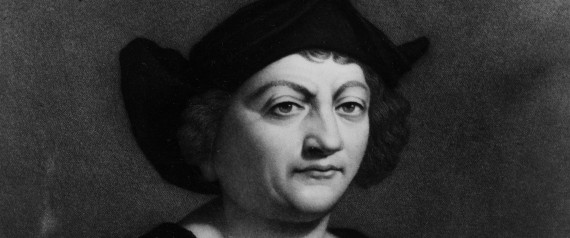
Once again, it's time to celebrate Columbus Day. Yet, the stunning truth is: If Christopher Columbus were alive today, he would be put on trial for crimes against humanity. Columbus' reign of terror, as documented by noted historians, was so bloody, his legacy so unspeakably cruel, that Columbus makes a modern villain like Saddam Hussein look like a pale codfish.
Question: Why do we honor a man who, if he were alive today, would almost certainly be sitting on Death Row awaiting execution?
If you'd like to know the true story about Christopher Columbus, please read on. But I warn you, it's not for the faint of heart.
Here's the basics. On the second Monday in October each year, we celebrate Columbus Day (this year, it's on October 11th). We teach our school kids a cute little song that goes: "In 1492, Columbus sailed the ocean blue." It's an American tradition, as American as pizza pie. Or is it? Surprisingly, the true story of Christopher Columbus has very little in common with the myth we all learned in school.
Columbus Day, as we know it in the United States, was invented by the Knights of Columbus, a Catholic fraternal service organization. Back in the 1930s, they were looking for a Catholic hero as a role-model their kids could look up to. In 1934, as a result of lobbying by the Knights of Columbus, Congress and President Franklin Roosevelt signed Columbus Day into law as a federal holiday to honor this courageous explorer. Or so we thought.
There are several problems with this. First of all, Columbus wasn't the first European to discover America. As we all know, the Viking, Leif Ericson probably founded a Norse village on Newfoundland some 500 years earlier. So, hat's off to Leif. But if you think about it, the whole concept of discovering America is, well, arrogant. After all, the Native Americans discovered North America about 14,000 years before Columbus was even born! Surprisingly, DNA evidence now suggests that courageous Polynesian adventurers sailed dugout canoes across the Pacific and settled in South America long before the Vikings.
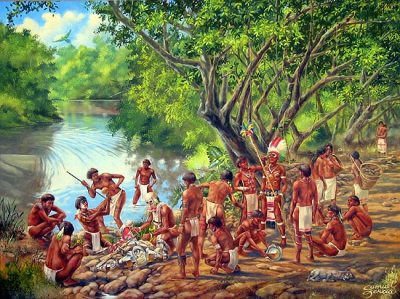
Second, Columbus wasn't a hero. When he set foot on that sandy beach in the Bahamas on October 12, 1492, Columbus discovered that the islands were inhabited by friendly, peaceful people called the Lucayans, TaĆ­nos and Arawaks. Writing in his diary, Columbus said they were a handsome, smart and kind people. He noted that the gentle Arawaks were remarkable for their hospitality. "They offered to share with anyone and when you ask for something, they never say no," he said. The Arawaks had no weapons; their society had neither criminals, prisons nor prisoners. They were so kind-hearted that Columbus noted in his diary that on the day the Santa Maria was shipwrecked, the Arawaks labored for hours to save his crew and cargo. The native people were so honest that not one thing was missing.
Columbus was so impressed with the hard work of these gentle islanders, that he immediately seized their land for Spain and enslaved them to work in his brutal gold mines. Within only two years, 125,000 (half of the population) of the original natives on the island were dead.
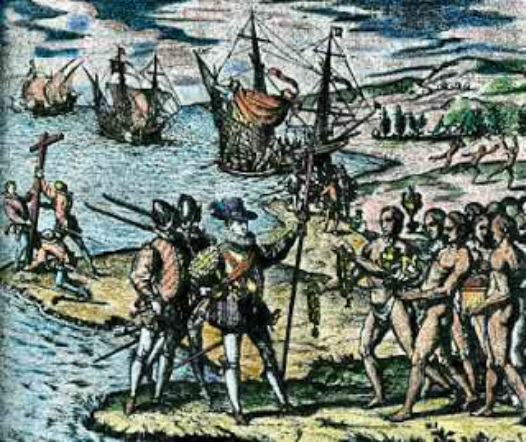
If I were a Native American, I would mark October 12, 1492, as a black day on my calendar.
Shockingly, Columbus supervised the selling of native girls into sexual slavery. Young girls of the ages 9 to 10 were the most desired by his men. In 1500, Columbus casually wrote about it in his log. He said: "A hundred castellanoes are as easily obtained for a woman as for a farm, and it is very general and there are plenty of dealers who go about looking for girls; those from nine to ten are now in demand."
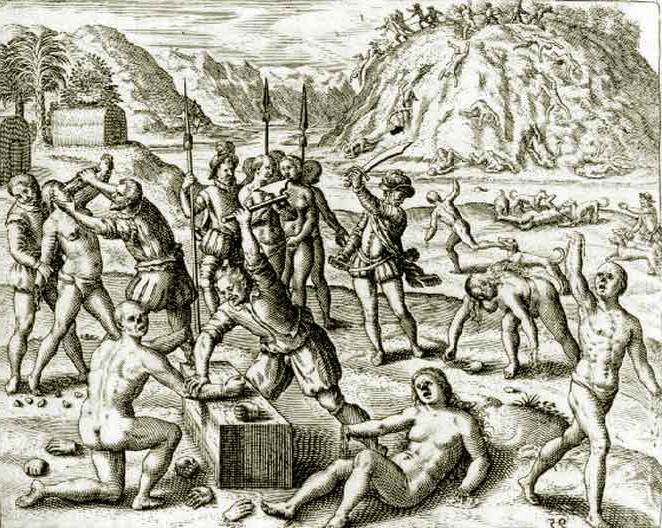
He forced these peaceful natives work in his gold mines until they died of exhaustion. If an "Indian" worker did not deliver his full quota of gold dust by Columbus' deadline, soldiers would cut off the man's hands and tie them around his neck to send a message. Slavery was so intolerable for these sweet, gentle island people that at one point, 100 of them committed mass suicide. Catholic law forbade the enslavement of Christians, but Columbus solved this problem. He simply refused to baptize the native people of Hispaniola.
On his second trip to the New World, Columbus brought cannons and attack dogs. If a native resisted slavery, he would cut off a nose or an ear. If slaves tried to escape, Columbus had them burned alive. Other times, he sent attack dogs to hunt them down, and the dogs would tear off the arms and legs of the screaming natives while they were still alive. If the Spaniards ran short of meat to feed the dogs, Arawak babies were killed for dog food.
Columbus' acts of cruelty were so unspeakable and so legendary - even in his own day - that Governor Francisco De Bobadilla arrested Columbus and his two brothers, slapped them into chains, and shipped them off to Spain to answer for their crimes against the Arawaks. But the King and Queen of Spain, their treasury filling up with gold, pardoned Columbus and let him go free.
One of Columbus' men, Bartolome De Las Casas, was so mortified by Columbus' brutal atrocities against the native peoples, that he quit working for Columbus and became a Catholic priest. He described how the Spaniards under Columbus' command cut off the legs of children who ran from them, to test the sharpness of their blades. According to De Las Casas, the men made bets as to who, with one sweep of his sword, could cut a person in half. He says that Columbus' men poured people full of boiling soap. In a single day, De Las Casas was an eye witness as the Spanish soldiers dismembered, beheaded, or raped 3000 native people. "Such inhumanities and barbarisms were committed in my sight as no age can parallel," De Las Casas wrote. "My eyes have seen these acts so foreign to human nature that now I tremble as I write."
De Las Casas spent the rest of his life trying to protect the helpless native people. But after a while, there were no more natives to protect. Experts generally agree that before 1492, the population on the island of Hispaniola probably numbered above 3 million. Within 20 years of Spanish arrival, it was reduced to only 60,000. Within 50 years, not a single original native inhabitant could be found.
In 1516, Spanish historian Peter Martyr wrote: "... a ship without compass, chart, or guide, but only following the trail of dead Indians who had been thrown from the ships could find its way from the Bahamas to Hispaniola."
Christopher Columbus derived most of his income from slavery, De Las Casas noted. In fact, Columbus was the first slave trader in the Americas. As the native slaves died off, they were replaced with black slaves. Columbus' son became the first African slave trader in 1505.
Are you surprised you never learned about any of this in school? I am too. Why do we have this extraordinary gap in our American ethos? Columbus himself kept detailed diaries, as did some of his men including De Las Casas and Michele de Cuneo. (If you don't believe me, just Google the words Columbus, sex slave, and gold mine.)
Columbus' reign of terror is one of the darkest chapters in our history. The REAL question is: Why do we celebrate a holiday in honor of this man? (Take three deep breaths. If you're like me, your stomach is heaving at this point. I'm sorry. Sometimes the truth hurts. That said, I'd like to turn in a more positive direction.)
Call me crazy, but I think holidays ought to honor people who are worthy of our admiration, true heroes who are positive role models for our children. If we're looking for heroes we can truly admire, I'd like to offer a few candidates. Foremost among them are school kids.
Let me tell you about some school kids who are changing the world. I think they are worthy of a holiday. My friend Nan Peterson is the director of the Blake School, a K-12 school in Minnesota. She recently visited Kenya. Nan says there are 33 million people in Kenya... and 11 million of them are orphans! Can you imagine that? She went to Kibera, the slum outside Nairobi, and a boy walked up to her and handed her a baby. He said: My father died. My mother died... and I'm not feeling so good myself. Here, take my sister. If I die, they will throw her into the street to die.
There are so many orphans in Kenya, the baby girls are throwaways!
Nan visited an orphanage for girls. The girls were starving to death. They had one old cow that only gave one cup of milk a day. So each girl only got ONE TEASPOON of milk a day!
After this heartbreaking experience, Nan went home to her school in Minnesota and asked the kids... what can we do? The kids got the idea to make homemade paper and sell it to buy a cow. So they made a bunch of paper, and sold the paper, and when they were done they had enough money to buy... FOUR COWS! And enough food to feed all of the cows for ONE FULL YEAR! These are kids... from 6 years old to 18... saving the lives of kids halfway around the world. And I thought: If a 6-year-old could do that... what could I do?
At Casady School in Oklahoma City, Oklahoma, seemingly "average" school kids raised $20,000 to dig clean water wells for children in Ethiopia. These kids are heroes. Why don't we celebrate "Kids Who Are Changing the Planet" Day?
Let me ask you a question: Would we celebrate Columbus Day if the story of Christopher Columbus were told from the point-of-view of his victims? No way!
The truth about Columbus is going to be a hard pill for some folks to swallow. Please, don't think I'm picking on Catholics. All the Catholics I know are wonderful people. I don't want to take away their holiday or their hero. But if we're looking for a Catholic our kids can admire, the Catholic church has many, many amazing people we could name a holiday after. How about Mother Teresa day? Or St. Francis of Assisi day? Or Betty Williams day (another Catholic Nobel Peace Prize winner). These men and women are truly heroes of peace, not just for Catholics, but for all of us.
Let's come clean. Let's tell the truth about Christopher Columbus. Let's boycott this outrageous holiday because it honors a mass murderer. If we skip the cute song about "In 1492 Columbus sailed the ocean blue," I don't think our first graders will miss it much, do you? True, Columbus' brutal treatment of peaceful Native Americans was so horrific... maybe we should hide the truth about Columbus until our kids reach at least High School age. Let's teach it to them about the same time we tell them about the Nazi death camps.
While we're at it, let's rewrite our history books. From now on, instead of glorifying the exploits of mass murderers like Alexander the Great, Julius Caesar, Genghis Khan, and Napoleon Bonaparte, let's teach our kids about true heroes, men and women of courage and kindness who devoted their lives to the good of others. There's a long list, starting with Florence Nightingale, Mahatma Gandhi, Rev. Martin Luther King, and John F. Kennedy.
These people were not adventurers who "discovered" an island in the Caribbean. They were noble souls who discovered what is best in the human spirit.
Why don't we create a holiday to replace Columbus Day?
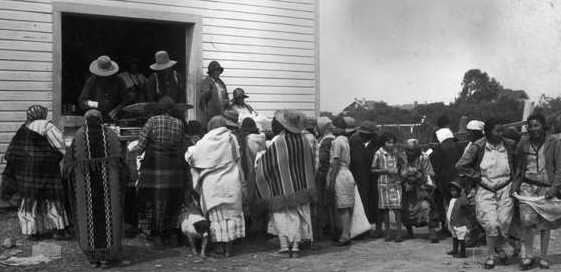
The Ration Card: Ugly Remnant of How U.S. Decimated Indian Culture

Tuesday, October 7, 2014

Of the some 136 million objects and specimens in the grand Smithsonian collections, most carry an implied positive energy, or a promise of better things to come, or sometimes just simple joy. But there are also, though fewer, things of a darker mien, artifacts revealing caliginous corners of American history, including one so unimposing in size and materials as to appear insignificant; you could slip it into a shirt pocket, forget it’s there and run it through to its destruction in the wash.
About the size of a business card or a major-league bleachers ticket, this little piece of heavy, printed paper is the federal government’s substitute for the bison of the Great Plains, that source of life and culture that unknown thousands of aboriginal Americans depended on for generations beyond counting. Until the ghost dance generation—the one that kissed the old life goodbye to face an enemy future—the tribes that dominated the grasslands for 8,000 years fought most of their battles over bison hunting grounds. The red people ate bison, dressed in bison, imitated and talked to bison, and died for and by the sacred bison.
This ration ticket, this seeming inconsequential token of conquest and devastation, is the graphic expression of an 1883 act of Congress that furthered the appropriation of Indian lands west of the Missouri by moving tribal peoples onto assigned reservations, where, proclaims the act, “they may live after the manner of white men.” The reality was something else. The enforced reservation system meant native, nomadic tribes could live neither like white men—unless those whites were indigents—nor like the red men they had so recently been.
The ration ticket shown here was issued in the mid-1880s to someone called Woman’s Dress (perhaps, though not certainly, a female head of family), a member of the Oglala Lakota tribe quartered on the Pine Ridge reservation in the southwest corner of what is today South Dakota. Pine Ridge in our time lies almost in the shadow of Mount Rushmore and its four granite presidential physiognomies, none of whom would have perceived the sorrow resident in this paper faux-bison. The penned numeral nine probably indicates Woman’s Dress was allowed to draw rations of beef—and, also when available, beans, corn, flour, salt, and occasionally sugar, coffee, soap and tobacco—for nine dependents each Saturday.
Never mind that the flour and grains sometimes had gone moldy or that most of the Indians found the taste of beef no match for the rich flavor of bison. For these foreign and sorry substitutions, Indian men no longer able to support themselves sometimes had to perform labor. An Oglala Lakota once memorably said to me, “They take our land, they take our hunting and then they force us to work for food that made us sick.”
When this ticket was issued, the Plains bison had largely been exterminated, an extirpation heavily assisted by white hunters who would slaughter bison for nothing more than the delicacy of its tongue or merely for the pleasure of the kill. In the winter of 1884, government rations were so deficient on the Blackfoot reservation in Montana, the people suffered from malnutrition: A quarter of them died of starvation. They couldn’t eat paper.
Perhaps it was Woman’s Dress who decorated the ticket with a rawhide thong partly wrapped with dyed porcupine quills and finial cones of tin. I see that craft as an attempt to give it a touch of cultural meaning once rendered to a real bison, an attempt to turn a piece of bureaucracy and (ironically)red tape into something at least suggesting the sacred. Not uncommonly, Plains Indians also made beautifully decorated, cow-leather pouches to carry and protect their tickets. With quills and tin, the people tried to put a benign face on a graphic token of a blatantly imperialistic action worked upon those who had lived on the land for 15,000 years.
The lower third of the ticket, once imprinted with the dates for collecting rations, shows each numeral punched out with a hole in the shape of a cross. Whether that figure is deliberate, I don’t know, but it surely appears symbolic.
The degree of genuine humanity and generosity behind the rationing system is revealed by a remark in the 1850 Annual Report of the Commissioner of Indian Affairs: “It is, in the end, cheaper to feed the whole flock for a year than to fight them for a week.” Two years later, Gen. E. D. Townsend wrote in his California Diary of the Indians facing pressure from the 1849 gold rush: “If the tale of the poor wretches... could be impartially related, it would exhibit a picture of cruelty, injustice, and horror scarcely surpassed by that of the Peruvians in the time of Pizarro.”
A memoirist and novelist of English, Irish and Osage ancestry, William Least Heat-Moon says his research into 1880s Indian ration tickets was “some of the saddest work I’ve ever done.” This piece originally appeared in the November 2013 issue of SMITHSONIAN Magazine.


16 Of The Most Evil Women In History

Sunday, September 14, 2014

Serial killers and other evil actions are generally attributed to men, but these women certainly proved that evil deeds are not limited to just one sex. The brutality and horror in the hearts of these women is unbelievably cruel. Some of these women make Hannibal Lecture look civilized!


16. Enriqueta Marti

This cruel woman preyed on homeless children and would put them into prostitution or murder them and use their remains for ointments that she claimed cured tuberculosis. She was eventually arrested and hung by her prison mates before trial.


15. Aileen Wuornos

Having a difficult childhood, Aileen grew up hating all men and became a serial killer. She stole cars, stuck up convenience stores and killed a lot of different men before she was arrested and killed in 2002. A movie titled "Monster" demonstrates her life.


14. Wu Zetian

This evil Chinese empress put countless people to death for threatening her rule. She even put her own infant daughter to death as well as other family members.


13. Queen Mary I

This Catholic queen murdered all Protestants in England and was nicknamed Bloody Mary. Every Protestant was forced to flee England in order to survive until Queen Mary died in 1558.


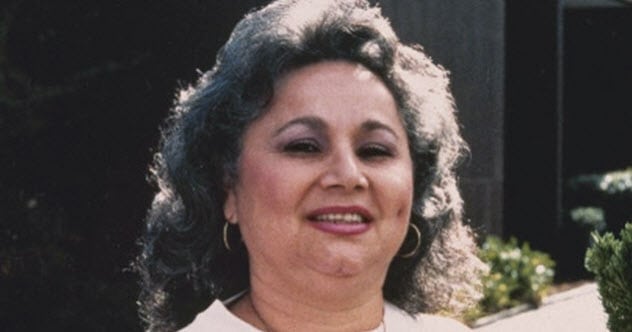
12. Griselda Blanco

This infamous "cocaine godmother," who was already kidnapping and murdering children at age 11, ran the cocaine trade with murderous force in New York and Miami before being shot in the head in 2012. HBO will release Cocaine Godmother in 2018.

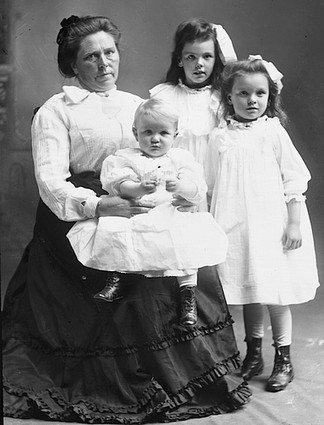
 11. Belle Gunness

She killed her three children and husband, used the insurance money to buy a home, remarried and killed his infant daughter and him as well. She then took out an ad as an eligible widow with property. Each prospective buyer would be killed and robbed. She left the country after 40 separate murders and was never found.


10. Ilse Koch

This Nazi wife tortured and killed many Jewish inmates and made lampshades and other household items out of their skin.


9. Irma Grese

This Nazi woman tortured and killed Jewish women who were more attractive than herself. She believed she would have a career in the movies once Germany won World War II but instead was hanged for her crimes in 1945.


8. Katherine Knight

Knight is known for strangling her husband for falling asleep during sex, slitting a boyfriends dog’s throat right in front of him and most infamously stabbing a man 37 times, decapitating him, hanging his body on a meat hook and attempting to feed his cooked body parts to his children.


7. Elizabeth Bathory

Using her political status as a murder hungry housewife in the 16th century, she was responsible for the torture and murder of over 650 women whom would be lured into her castle in hopes of finding a job. (Despite the evidence against Elizabeth, her family's influence kept her from facing trial. She was imprisoned in December 1610 within Csejte CastleUpper Hungary, now in Slovakia, where she remained immured in a set of rooms until her death four years later.)


6. Lizzie Borden

Accused of murdering her family with an ax, she was one of the first criminal cases to gain nationwide attention. Acquitted after trial, speculation continues to this day -- as her guilt is still widely assumed.


5. Maria 'Chata' Leon

As the head of The Avenues, Chata ran one of the most dangerous street gangs in the history of Los Angeles. From her fortress home on Drew St, she ran a criminal enterprise based on drugs, murder, and intimidation. Much of the gang's higher leadership was made up of her children.


4. Myra Hindley

Together with her boyfriend, Ian Brady, Hindley was responsible for the rape and murder of five young children between 1962-68. Hindley died in prison in 2002.


3. Dorothea Binz

As the SS supervisor at the Ravensbruck concentration camp, her dedication to her work was described by her fellow Nazis as "unyielding." Known for patrolling the camp with a whip in one hand and a German Shepard in the other, inmates reportedly fell silent upon her approach. Her reputation of whipping, beating, and even shooting female inmates earned her the position of supervising the torture bunkers at the camp as well as training guards.

2. Biljana PlavÅ”ić

As the former president of Republika Srpska, she lead Bosnia-Herzegovina during the Serbian genocides of the 1990s. It was her comments that ethnic cleansing was a "natural thing" and that six million Serbs needed to die, that rallied her republic to perpetrate genocide. After her arrest, she plea bargained with the war crimes tribunal and remained in prison until her release in 2009. She is currently staging a political comeback.


1. Fusako Shigenobu

After a career as a student activist, she volunteered with the PLO before forming the
Japanese Red Army. In her attempts to unite Japan under Communist revolution, she became a full-fledged terrorist. She is responsible for orchestrating the 1974 attack on the French embassy in The Hague, and assisting the 1960 hijacking of TWA flight 840. Until her arrest in 2000, she was the most wanted terrorist on Earth.

When lying is a good thing

Wednesday, September 10, 2014

An obvious cliche is defined by one the most natural and primitive motive by human nature: lying.  Why is it such a cliche?  Well, I’m not going to blow smoke up your ass, or tell a cock ‘n bull story,  or pee on your leg and tell you it’s raining,  because, I’m quite sure you’ve heard it all before so I don’t need to reinvent the wheel.  The art of lying is much older than the oldest profession in the world, and yes, both are considered viral and can be harmful.  After all, who wants to get caught with their pants down in either situation?
Of course lying leads down the road of questioning morality.  Large lies are destructive.  Marriages and friendships fall apart.  Wars rage on.  Politicians stay in business.  You know the deal.  Small lies are forgivable.  We don’t want to hurt people’s feelings with the small stuff.  Or we just don’t really feel like going to work or taking our kids to the park because we’re just too tired and need a break.  So the margin between how we justify telling lies can easily be deluded or misunderstood, thereby creating this moral conundrum.
I am one of the biggest liars I know. Every time I sit in front of a computer I tell lies consistently, obsessively. Why?  Because I write fiction. The stories I tell are half true, half false.  And the best part about it, you believe what I tell. When you begin to process that concept, it’s really an incredible experience we both share, and it’s as natural as breathing. Logically we should reject this acceptance. My father, the engineer, rejects it. He doesn’t read fiction because he would rather fill his mind with information that’s legitimate and direct. But for the rest of us, we not only marvel in it, we dip our entire souls into it because it feels good. It releases a part of our imagination that we can’t operate in the physical world.

So, yes, I write fiction. And I write fiction with a historical twist. Although I dig deeply into research, I chose to reproduce history in a fictitious form. It’s like having immunity. I can break off story lines from real events, and then turn around to commit forgery without blame.  If you think about it, it sounds bad; however there is a legitimate purpose.  Fiction, like all other art, serves a higher calling. It allows an opportunity to blend real-life people into one character as a representative, a symbol of who that character represents, whether a crusader for equality or an irredeemable brute, to bring forth criticism and awareness. Fiction doesn’t fall far from the truth. It has to come from somewhere authentic, otherwise readers will have no commonality to grasp upon.
I believe writing about history in a fictional context can be intellectually, spiritually, and humanely liberating. Fact or fiction, the art of lying unveils misconceptions about ourselves, our humanity, and our future. We lie, we reinforce. We gossip, we self-destruct. We seek, we fail. We grow, we die. But always we hope. To escape. To learn. To rediscover. To reinvent. It matters, all, it matters because we are here. I encourage this philosophy: Submitting to a moment in time allows us to remember, or to muse even, over our society’s past. Although writing can educate as well as entertain, yet what makes art incredibly amazing, to that of paintings, photographs, and music, it transposes emotion into another form of humanity, and therefore, it is our humanity which keeps all of us striving for an improved future.
So, if you think I’m trying to pull wool over your eyes, or even trying to pull your leg, then you’re right. I am. That’s my job.  And I hope you ponder over what I tell you.  Let us explore our vices outside of our everyday life. Let us think about how reading fiction, that, although is regarded as false and abstract, can reveal truths about ourselves. About our humanity. And allow a freedom to examine these controversies with creativity and heart. This type of lying can actually be a good thing.